I just wanted to say that the page is under construction, that's why it's looking a little messed up right now. I'm working on improving the header image and blog description as well as a number of other things.
I think I like this look compared to the old look. Feel free to comment and let me know which one you like better!
Also, should say that new content is coming soon,like very soon, like tonight. I'm working on a post right no. unfortunately for those who have asked its not the Ringed Plover article. It's another weather analysis style post chalk full with some useful insight and lots of idle speculation. Anyway, look for that soon!
ps: I promise the Ringed Plover article will happen :/
Friday, October 7, 2011

Friday, September 23, 2011
Comparing Two "Events"
Well,not surprisingly Hurricane Maria was a bust for pelagic birds. The storm was not set up properly and the tremendous speed with which it spun through Newfoundland made for less then ideal circumstances for sending hurricane waifs to our shores. Although the center of the hurricane passed over the Avalon Peninsula the storm was partially torn apart by strong wind shear from days previous. It became warped further as it entered the cold waters surrounding Newfoundland. This meant that most of the storms force lay in the NE quadrant, which passed east of Newfoundland. Maria produced peak gusts at Cape Race of 108 km/hr. For those of you who know of and have birded Cape Race,this equates to just another windy day at the Cape.
In analyzing this storm during its approach I quickly became more exited by the low pressure system that was moving up the eastern seaboard (responsible for directing Maria towards NL, away from the Eastern Seaboard). In years past fast moving lows (that coincide with offshore tropical systems) that sweep up the eastern seaboard, or move in from the Great Lakes have produced large arrivals of passerines.It was my hope that the same thing might occur when I started looking at the weather maps for Thursday September 15th and Friday September 16th.
In the following paragraphs I'll compare Maria and her associated low with Tropical Storm Chantelle of September 2007 and a low pressure system that swallowed it up and passed over Newfoundland. There are some interesting similarities and differences in the two storms, but as we'll see both looked very similar on weather maps and both produced a fallout of passerines on the eastern Avalon Peninsula, namely on Bear Cove Pt Rd.
Geography
Bear Cove Pt Rd is located within the town of Renews about half way down the eastern shore of the Avalon Peninsula. There are two factors which I believe make this road an excellent migrant trap.
1) position- the end of the road is located at a headland which juts out from the coast,perhaps improving this location as landfall point. As well, there is a lighthouse at the point, which might serve as a beacon for wayward birds traveling in the dark. Light beams from lighthouses have long been thought to attract birds.
2) habitat- much of the coastline of the Avalon Peninsula is dominated by barrens and stunted conifers. This is not exactly th preferred habitat for Neotropical migrants. However,when these areas are disturbed by the building of roads there is often a flush of second growth that sprouts up along the roads. In many cases, in Newfoundland Alder bushes grow en mass along these coastal roads. Compared to the surrounding barrens and conifers these alders beds look like oasis' to weary migrating passerines.

zoomed out map showing the location of Bear Cove Pt in Newfoundland

Zoomed in map showing a more local view of Bear Cove Pt
So now that the location for the events has been explained, lets take a look at the weather that helped make it happen. On September 11 2007 there was a deep trough in the jet stream created by a deepening low pressure system over western Ontario. There are also two other low pressure systems located north of Hudson's Bay and Labrador.As you can see by looking at the weather map below there were winds blowing from the Great Lakes directly to Newfoundland. The following day the more northerly low pressure systems moved farther south creating a strong south westerly flow.On the third day Thursday,September 13th, this flow of air that had been SW of the Great Lakes on Tuesday,into Cape Cod and the Maritimes on Wednesday, was now flowing into Newfoundland. When looking at the weather maps pay special attention to the area where the isobars are tightly packed and notice how that tightly packed area moves west to east over the three days.
Fastforwarding 5 years we had a similar system (September 15-17) that brought a big influx of birds to the eastern Avalon Peninsula. Once again there was a deep trough in the jet stream caused by a low pressure system over Ontario and there was again corresponding low positioned to the north over Labrador and Northern Quebec. Looking at the weather map notice how tigtly packed the isobars are over the western Great Lakes, exactly as they were on September 14th, 2007. Once again, just as in 2007 the more northerly low advances south, this time combining with the low over the Great lakes to form a large, formidable low pressure system that was driving air from the southern Great Lakes towards Newfoundland.Between September 15th and 16th the winds whipped through Cape Cod and the Canadian Maritimes, just as they did from September 11th-13th of 2007. The winds made it to Newfoundland by Saturday, September 17th as strong Westerly and South westerlies. On the two days following the passage of the large numbers and a good diversity of passerines were found along Bear Cove Pt Rd.
It took each system three days to make it from the Great Lakes to Newfoundland and on the forth day a fallout of passerines was evident. Below I've paired the days 1,2 and 3 of the 2007 and the recent 2011 systems so you can see the similarities.
September 11th 2007 September 15th 2011

September 12th 2007 September 16th 2011

September 13th 2007 September 17th 2011
Included below that is a chart that compares the warbler species found after the passge of each system.
There is more to birding then just learning how to identify birds. Gaining an understanding of how weather drive patterns of vagrancy give a birder a significant edge when deciding when and where to concentrate their efforts. Sure anyone can go out and stumble into a rarity but the informed birder know what to expect, where to expect it and knows how to identify it. Of course, it's far from a perfect science and there is still a lot of guess work involved but the more time we spend analyzing weather and then comparing it to bird movements in our area the better we get at predicting events such as those described above.
In analyzing this storm during its approach I quickly became more exited by the low pressure system that was moving up the eastern seaboard (responsible for directing Maria towards NL, away from the Eastern Seaboard). In years past fast moving lows (that coincide with offshore tropical systems) that sweep up the eastern seaboard, or move in from the Great Lakes have produced large arrivals of passerines.It was my hope that the same thing might occur when I started looking at the weather maps for Thursday September 15th and Friday September 16th.
In the following paragraphs I'll compare Maria and her associated low with Tropical Storm Chantelle of September 2007 and a low pressure system that swallowed it up and passed over Newfoundland. There are some interesting similarities and differences in the two storms, but as we'll see both looked very similar on weather maps and both produced a fallout of passerines on the eastern Avalon Peninsula, namely on Bear Cove Pt Rd.
Geography
Bear Cove Pt Rd is located within the town of Renews about half way down the eastern shore of the Avalon Peninsula. There are two factors which I believe make this road an excellent migrant trap.
1) position- the end of the road is located at a headland which juts out from the coast,perhaps improving this location as landfall point. As well, there is a lighthouse at the point, which might serve as a beacon for wayward birds traveling in the dark. Light beams from lighthouses have long been thought to attract birds.
2) habitat- much of the coastline of the Avalon Peninsula is dominated by barrens and stunted conifers. This is not exactly th preferred habitat for Neotropical migrants. However,when these areas are disturbed by the building of roads there is often a flush of second growth that sprouts up along the roads. In many cases, in Newfoundland Alder bushes grow en mass along these coastal roads. Compared to the surrounding barrens and conifers these alders beds look like oasis' to weary migrating passerines.

zoomed out map showing the location of Bear Cove Pt in Newfoundland

Zoomed in map showing a more local view of Bear Cove Pt
So now that the location for the events has been explained, lets take a look at the weather that helped make it happen. On September 11 2007 there was a deep trough in the jet stream created by a deepening low pressure system over western Ontario. There are also two other low pressure systems located north of Hudson's Bay and Labrador.As you can see by looking at the weather map below there were winds blowing from the Great Lakes directly to Newfoundland. The following day the more northerly low pressure systems moved farther south creating a strong south westerly flow.On the third day Thursday,September 13th, this flow of air that had been SW of the Great Lakes on Tuesday,into Cape Cod and the Maritimes on Wednesday, was now flowing into Newfoundland. When looking at the weather maps pay special attention to the area where the isobars are tightly packed and notice how that tightly packed area moves west to east over the three days.
Fastforwarding 5 years we had a similar system (September 15-17) that brought a big influx of birds to the eastern Avalon Peninsula. Once again there was a deep trough in the jet stream caused by a low pressure system over Ontario and there was again corresponding low positioned to the north over Labrador and Northern Quebec. Looking at the weather map notice how tigtly packed the isobars are over the western Great Lakes, exactly as they were on September 14th, 2007. Once again, just as in 2007 the more northerly low advances south, this time combining with the low over the Great lakes to form a large, formidable low pressure system that was driving air from the southern Great Lakes towards Newfoundland.Between September 15th and 16th the winds whipped through Cape Cod and the Canadian Maritimes, just as they did from September 11th-13th of 2007. The winds made it to Newfoundland by Saturday, September 17th as strong Westerly and South westerlies. On the two days following the passage of the large numbers and a good diversity of passerines were found along Bear Cove Pt Rd.
It took each system three days to make it from the Great Lakes to Newfoundland and on the forth day a fallout of passerines was evident. Below I've paired the days 1,2 and 3 of the 2007 and the recent 2011 systems so you can see the similarities.
 |
| Add caption |

September 12th 2007 September 16th 2011

September 13th 2007 September 17th 2011
Included below that is a chart that compares the warbler species found after the passge of each system.
There is more to birding then just learning how to identify birds. Gaining an understanding of how weather drive patterns of vagrancy give a birder a significant edge when deciding when and where to concentrate their efforts. Sure anyone can go out and stumble into a rarity but the informed birder know what to expect, where to expect it and knows how to identify it. Of course, it's far from a perfect science and there is still a lot of guess work involved but the more time we spend analyzing weather and then comparing it to bird movements in our area the better we get at predicting events such as those described above.
Wednesday, September 14, 2011
Speculations About Maria
Well it looks as though we are going to get hit by Tropical Storm/ Tropical Depression Maria. To be quite honest I'm not sure what to expect from this storm. The storm has never been that strong, with winds maxing out at Tropical Storm strength. It has lost many of its tropical characteristics, it does not have much in the way of surface rotation or spiral bands and it's not expected to intensify much, if at all, before it reaches us.
The storm has been out at sea the entire time only coming close to land near the Northern Antilles islands. Due to its pelagic nature its very unlikely that Maria will bring any land birds with it.However, it still might have the potential to carry a rare tern or two our way. It isn't the type of storm that will entraiin birds and drag them long distances, but it's moderately strong winds could certainly persuade some birds in our direction.
I'm still trying to develop a game plan for birding this storm. Right now it's expected that the storm will pass through eastern Newfoundland, somewhere near the Avalon Peninsula and the winds are forecast to be from the south. This isn't exactly the most productive direction to produce a movement of sea birds but southern facing points on the Avalon could be good, that is if it's not too foggy to see!
I'll probably try my luck at Cape Spear. This location is generally better in a N or NW wind, but I've seen some good sea bird movements on southerly winds here as well. If the winds get up to 60+km/hr sustained you can expect to see Storm Petrels and some other tubenoses going by.
If the storm tracks futher to the east and generates N or NE wrap around winds after it passes, then there could be a nice movement and birds like Leach's Storm Petrels and Jaegers will be pushed into Conception Bay. If this happens places like Kelligrews, Seal Cove and Holyrood will be worth checking.
The day after the storm passes it will be well worth checking all coves and beaches on the Avalon Peninsula for any tired storm birds. Possible species (no matter how unlikely) are Black Tern, Least Tern, Sooty Tern, Bridled Tern and Magnificent Frigatebird. Just look everywhere and at every tern. Photograph anything unfamiliar and get the word out if you think you have something unusual.
Good luck!!
The storm has been out at sea the entire time only coming close to land near the Northern Antilles islands. Due to its pelagic nature its very unlikely that Maria will bring any land birds with it.However, it still might have the potential to carry a rare tern or two our way. It isn't the type of storm that will entraiin birds and drag them long distances, but it's moderately strong winds could certainly persuade some birds in our direction.
I'm still trying to develop a game plan for birding this storm. Right now it's expected that the storm will pass through eastern Newfoundland, somewhere near the Avalon Peninsula and the winds are forecast to be from the south. This isn't exactly the most productive direction to produce a movement of sea birds but southern facing points on the Avalon could be good, that is if it's not too foggy to see!
I'll probably try my luck at Cape Spear. This location is generally better in a N or NW wind, but I've seen some good sea bird movements on southerly winds here as well. If the winds get up to 60+km/hr sustained you can expect to see Storm Petrels and some other tubenoses going by.
If the storm tracks futher to the east and generates N or NE wrap around winds after it passes, then there could be a nice movement and birds like Leach's Storm Petrels and Jaegers will be pushed into Conception Bay. If this happens places like Kelligrews, Seal Cove and Holyrood will be worth checking.
The day after the storm passes it will be well worth checking all coves and beaches on the Avalon Peninsula for any tired storm birds. Possible species (no matter how unlikely) are Black Tern, Least Tern, Sooty Tern, Bridled Tern and Magnificent Frigatebird. Just look everywhere and at every tern. Photograph anything unfamiliar and get the word out if you think you have something unusual.
Good luck!!
Monday, September 12, 2011
#247 Bagged
On September 11th I set off for a day birding with good friend Jarod Clarke. Jarod and I have had some good success birding together in recent years so the day was filled with promise. For example last October we put together a nice string of rarities that included, Blue Grosbeak,Indigo Bunting,Scarlet Tanager,Grasshopper Sparrow, Hooded Warbler and I know there were a couple of others that got away. The year before we managed to pull off a rare 5 species of Vireo day on the southern Avalon Peninsula. This might not seem overly impressive, but when you consider that there aren't any breeding Vireos in eastern Newfoundland, then you see how significant this was. Of particular note were a Warbling and Yellow-throated Vireo. Added to the Vireos were a Prairie Warbler, Yellow-breasted Chat and a Prothotary Warbler.Again not bad!
So we have a history of finding good birds, you get the picture. Since I was entering the day at 246 for the year ( only a single species from the NL year list record) I was feeling confident that the record would fall.
We decided to hit a well known migrant trap to start the day. We quickly found ourselves surrounded by warblers and sparrows. Before long we had Prairie Warbler- nice bird, but I already had seen one this year. We continued birding for migrants for the next couple of hours and added a few more interesting birds but nothing new for the year and after 3 hours digging in the alders we decided a change of scenery was in order. We headed for Bear Cove (100km S of St.John's),which was only a 7 minute drive from our location. The coastal deciduous shrubbery is well known among Newfoundland birders for its ability to collect weary migrants. The list of rarities that have been found there over the years is too long to mention but suffice to say that every Warbler and Vireo that breeds east of the Mississippi had been found there in the last decade! This was also the location of the Orchard Oriole and Golden-winged Warbler that I had found just two days earlier. To make a long story short, today was not the day to find a mega in Bear Cove. We were late getting there, the winds had picked up and the birds were keeping a low profile- no year birds here.
So, from there we headed South and I wasn't worried in the least since we were headed for Cape Race. I've mentioned Cape Race in previous posts. It's located at the extreme SE edge of the Avalon Peninsula and has a list of rarities that can compete with almost any birding location in North America. The Cape itself and the long dirt road leading to it have played host to some of the most extraordinary rarities in Newfoundland and North America, for that matter.
However, things were slow today. We pished the stunted trees along the coast hoping for an exhausted migrant, but nothing. We walked all around the grassy areas and the building at the Cape and again nothing. On our way out the road we were talking about how Cape Race had failed us when we flushed when Jarod yelled stop, what's that!! I slammed on the brakes and looked to the right, raising my bins at the same time. I got on a largish,plump passerine that was flying along side the car. It was immediately interesting, but what was it. We quickly went through the possibilities, Horned Lark, Pipit (the two most common possibilities). But wait it's bright below, Oriole, no that's not right. Then as the bird just passed by it clicked, Meadowlark!! We could not see the Black V as it flew by but the large size (for a passerine) the dumpy look, short tail with white outer tail feather, and pale sandy back and of course yellow under parts, all added up. The bird flew away with strong direct flight that consisted of a series of tight undulations. We watched it fly away, looking as though it wanted to land, but not landing. We lost it after about 100 meters and we failed to re find it.
So that was it, the Meadowlark was my 247th species of bird for Newfoundland this year and I was now co-owner of the Newfoundland year list record. We birded for another 4 hours without anything remarkable happening and got home around 9:00 pm to put an end to a 15 hour day.
It's 9:40 pm now and as I write this I'm thinking about tomorrow. I'll be birding the southern shore again and the next new species will give me sole ownership of the provincial year list record. I'll post an update tomorrow if I'm successful, otherwise it'll be a few days as I continue to work on the Ringed Plover article.
So we have a history of finding good birds, you get the picture. Since I was entering the day at 246 for the year ( only a single species from the NL year list record) I was feeling confident that the record would fall.
We decided to hit a well known migrant trap to start the day. We quickly found ourselves surrounded by warblers and sparrows. Before long we had Prairie Warbler- nice bird, but I already had seen one this year. We continued birding for migrants for the next couple of hours and added a few more interesting birds but nothing new for the year and after 3 hours digging in the alders we decided a change of scenery was in order. We headed for Bear Cove (100km S of St.John's),which was only a 7 minute drive from our location. The coastal deciduous shrubbery is well known among Newfoundland birders for its ability to collect weary migrants. The list of rarities that have been found there over the years is too long to mention but suffice to say that every Warbler and Vireo that breeds east of the Mississippi had been found there in the last decade! This was also the location of the Orchard Oriole and Golden-winged Warbler that I had found just two days earlier. To make a long story short, today was not the day to find a mega in Bear Cove. We were late getting there, the winds had picked up and the birds were keeping a low profile- no year birds here.
So, from there we headed South and I wasn't worried in the least since we were headed for Cape Race. I've mentioned Cape Race in previous posts. It's located at the extreme SE edge of the Avalon Peninsula and has a list of rarities that can compete with almost any birding location in North America. The Cape itself and the long dirt road leading to it have played host to some of the most extraordinary rarities in Newfoundland and North America, for that matter.
However, things were slow today. We pished the stunted trees along the coast hoping for an exhausted migrant, but nothing. We walked all around the grassy areas and the building at the Cape and again nothing. On our way out the road we were talking about how Cape Race had failed us when we flushed when Jarod yelled stop, what's that!! I slammed on the brakes and looked to the right, raising my bins at the same time. I got on a largish,plump passerine that was flying along side the car. It was immediately interesting, but what was it. We quickly went through the possibilities, Horned Lark, Pipit (the two most common possibilities). But wait it's bright below, Oriole, no that's not right. Then as the bird just passed by it clicked, Meadowlark!! We could not see the Black V as it flew by but the large size (for a passerine) the dumpy look, short tail with white outer tail feather, and pale sandy back and of course yellow under parts, all added up. The bird flew away with strong direct flight that consisted of a series of tight undulations. We watched it fly away, looking as though it wanted to land, but not landing. We lost it after about 100 meters and we failed to re find it.
So that was it, the Meadowlark was my 247th species of bird for Newfoundland this year and I was now co-owner of the Newfoundland year list record. We birded for another 4 hours without anything remarkable happening and got home around 9:00 pm to put an end to a 15 hour day.
It's 9:40 pm now and as I write this I'm thinking about tomorrow. I'll be birding the southern shore again and the next new species will give me sole ownership of the provincial year list record. I'll post an update tomorrow if I'm successful, otherwise it'll be a few days as I continue to work on the Ringed Plover article.
Saturday, September 10, 2011
Katia Passes, Bring on Marie
Well Hurricane Katia passed by south eastern Newfoundland today without coming within 300 miles of the nearest land at Cape Race. Due to this storms track far from land and it missing us by such a large margin its not thought that we will get any hurricane waifs from the storm. Having said that I'm still prepared to be surprised by a southern Tern or White-tailed Tropicbird. I'll be birding the Cape Race area tomorrow, so we'll see what's around then.
So Katia was a bust, but no worries there is a new storm that looks like it has some potential according to the latest model readings. This is the 95L that I alluded to the my last posting. It's fluctuated between Hurricane Marie and Tropical Storm Marie over the last couple of days. The storm is having trouble maintaining spin and organization and may in fact fizzle out to almost nothing before it even gets to us. However, it will be entering the warmer waters off the south eastern US in the next couple days and it could very well intensify. If Marie can get her act together and become a real Hurricane the current tracks suggest that it could head straight for eastern Newfoundland. Again, its not thought to get that close to the eastern seaboard, so even if we do get hit, it might not bring a birds. We'll have to wait and see. Here are what the current models are suggesting.

This shows the potential tracks that TS/Hurricane Marie might take over the next week. Tracks this far out are inherrently wrought with error, but the fact that all the models are suggesting a very similar course makes it quite likely that the actual track will be very similar to what's pictured here
BIG YEAR UPDATE
Over the last couple of days I added three new birds to my year list and picked up a a bonus bird when I realized that somehow I had forgotten to tick Common Redpoll. The other birds added were Dunlin, GOLDEN-WINGED WARBLER and ORCHARD ORIOLE.
The latter two species are extremely rare in the province. There are maybe 6-8 records of Golden-winged and perhaps just a single good record of Orchard Oriole and this was the second to be well documented and photographed in the province. The situation with Orchard Oriole in Newfoundland is an odd one because it seems to be underrepresented. The species is recorded several times annually in both New Brunswick and Nova Scotia, yes we have two records??!!The photos aren't among the best I've taken, but when your dealing with rarities documentation trumps aesthetics.


With the addition of the above mentioned species my current year total sits at 246. This is just one species short of the single year Newfoundland list record. My original goal of 260 species is well within reach. If I really go hard and we have an influx of good birds 270 might not be totally out of the question, although that's an almost unimaginable number. In fact, 247 was thought to be unbeatable and 260 was thought to be somewhat outlandish, so who knows!
I'm still working on the Common Ringed Plover piece. I need to dedicate a couple of hours to get it clued up. Look for it in the very near future.
So Katia was a bust, but no worries there is a new storm that looks like it has some potential according to the latest model readings. This is the 95L that I alluded to the my last posting. It's fluctuated between Hurricane Marie and Tropical Storm Marie over the last couple of days. The storm is having trouble maintaining spin and organization and may in fact fizzle out to almost nothing before it even gets to us. However, it will be entering the warmer waters off the south eastern US in the next couple days and it could very well intensify. If Marie can get her act together and become a real Hurricane the current tracks suggest that it could head straight for eastern Newfoundland. Again, its not thought to get that close to the eastern seaboard, so even if we do get hit, it might not bring a birds. We'll have to wait and see. Here are what the current models are suggesting.

This shows the potential tracks that TS/Hurricane Marie might take over the next week. Tracks this far out are inherrently wrought with error, but the fact that all the models are suggesting a very similar course makes it quite likely that the actual track will be very similar to what's pictured here
BIG YEAR UPDATE
Over the last couple of days I added three new birds to my year list and picked up a a bonus bird when I realized that somehow I had forgotten to tick Common Redpoll. The other birds added were Dunlin, GOLDEN-WINGED WARBLER and ORCHARD ORIOLE.
The latter two species are extremely rare in the province. There are maybe 6-8 records of Golden-winged and perhaps just a single good record of Orchard Oriole and this was the second to be well documented and photographed in the province. The situation with Orchard Oriole in Newfoundland is an odd one because it seems to be underrepresented. The species is recorded several times annually in both New Brunswick and Nova Scotia, yes we have two records??!!The photos aren't among the best I've taken, but when your dealing with rarities documentation trumps aesthetics.


With the addition of the above mentioned species my current year total sits at 246. This is just one species short of the single year Newfoundland list record. My original goal of 260 species is well within reach. If I really go hard and we have an influx of good birds 270 might not be totally out of the question, although that's an almost unimaginable number. In fact, 247 was thought to be unbeatable and 260 was thought to be somewhat outlandish, so who knows!
I'm still working on the Common Ringed Plover piece. I need to dedicate a couple of hours to get it clued up. Look for it in the very near future.
Monday, September 5, 2011
Katia Update and Looking Ahead
As promised here is an update on the track of Hurricane Katia. When I last posted a couple of days ago things were looking pretty exciting. The storm was forecast to track relatively close to the eastern seaboard then re curve to Newfoundland. Well, all of that has changed. Now it looks like Katia will come under the influence of a strong low pressure system ( remnants of TS Lee)which will steer it well off the coast of Newfoundland.

Note that all the models have Katia passing well east of Newfoundland. Good news for everyone but birders!
Having said that all is not lost. If the remnants of Lee remains relatively strong and sweeps up the coast combined with Katia, it could still bring us some stuff but will not have the potential to carry pelagic birds. If Katia gets within 200 miles of the eastern seaboard and then passes within 200 miles of Newfoundland it will still be worth looking for waifs that could have been carried in our general direction and then continued to our shores to rest.
Ok so it looks like Katia will be a bust but I'm an optimist. I'll just brush this let down aside and move on. While is this hugely disappointing my years of languishing as a Leafs and Cubs fan have taught me a thing or two about let downs and disappointment! So, just like there is always next season, there's always another storm. I guess its a toss as to what will happen first, a hurricane driven fallout of birds, a Toronto Maple Leahs Stanley Cup or a Cubs world series. Considering its been 54 years since our last hurricane fallout and 45 years since the Leafs last won the cup, it could be close! I won't even mention the Cubs!
Anyway, that next storm is on the horizon, well figuratively speaking. There is a system currently named 95L ( storms don't receive names until they reach tropical storm strength) that's developing off of Africa. This storm is already looking pretty organized with lots of heavy thunderstorms. Its in an area of extremely warm water and it looks to be destined to become a tropical storm and probably a hurricane. its' way too early to consider tracks but its forming south of where Katia formed,which will give it a better chance of getting close to the eastern seaboard. So I'll keep an eye on that one and update accordingly!

One can always hope!!
Look for something on Ringed Plover identification coming up. I found a juvenile Ringed Plover on the southern Avalon Peninsula two days ago. It's the 6th ( 3rd juvenile)I've found in Newfoundland and the 10th provincial record. As a juv its a bit tougher to id then an adult. I'll talk about some of the finer point of separating juvenile and Ringed and Semipalmated in the next update!
ps: the Ringed Plover was 239 on the year. This morning I added a Gnatcatcher for 240. That brings me within 8 birds of the Newfoundland big year record.

Note that all the models have Katia passing well east of Newfoundland. Good news for everyone but birders!
Having said that all is not lost. If the remnants of Lee remains relatively strong and sweeps up the coast combined with Katia, it could still bring us some stuff but will not have the potential to carry pelagic birds. If Katia gets within 200 miles of the eastern seaboard and then passes within 200 miles of Newfoundland it will still be worth looking for waifs that could have been carried in our general direction and then continued to our shores to rest.
Ok so it looks like Katia will be a bust but I'm an optimist. I'll just brush this let down aside and move on. While is this hugely disappointing my years of languishing as a Leafs and Cubs fan have taught me a thing or two about let downs and disappointment! So, just like there is always next season, there's always another storm. I guess its a toss as to what will happen first, a hurricane driven fallout of birds, a Toronto Maple Leahs Stanley Cup or a Cubs world series. Considering its been 54 years since our last hurricane fallout and 45 years since the Leafs last won the cup, it could be close! I won't even mention the Cubs!
Anyway, that next storm is on the horizon, well figuratively speaking. There is a system currently named 95L ( storms don't receive names until they reach tropical storm strength) that's developing off of Africa. This storm is already looking pretty organized with lots of heavy thunderstorms. Its in an area of extremely warm water and it looks to be destined to become a tropical storm and probably a hurricane. its' way too early to consider tracks but its forming south of where Katia formed,which will give it a better chance of getting close to the eastern seaboard. So I'll keep an eye on that one and update accordingly!

One can always hope!!
Look for something on Ringed Plover identification coming up. I found a juvenile Ringed Plover on the southern Avalon Peninsula two days ago. It's the 6th ( 3rd juvenile)I've found in Newfoundland and the 10th provincial record. As a juv its a bit tougher to id then an adult. I'll talk about some of the finer point of separating juvenile and Ringed and Semipalmated in the next update!
ps: the Ringed Plover was 239 on the year. This morning I added a Gnatcatcher for 240. That brings me within 8 birds of the Newfoundland big year record.
Thursday, September 1, 2011
Keeping an Eye on Katia and Revisiting Some Old Storms
It's been several months since I last updated this blog. I apologize to my regular readers for the lack of new content. I've gotten inordinately busy with work and life in general. But now that I'm back there are a couple of things I want to talk about.
My Newfoundland big year continues to chug along. It has been a great year for rarities and I've accumulated a list of 238 species seen to date. This currently sits just 9 species short of the Newfoundland year list record. If there are even a few gettable rarities this fall I will likely have a shot at my goal of 260. In my next post I'll do a bit of a recap of my year so far and will include photos and discussion of some of the rarities.
As well,we are in the middle of the Atlantic hurricane season. It has been the second most active season on record and promises to continue to be exciting in the next couple of months. This is not a topic I take lightly. Hurricanes cause enormous damage and disrupt bird populations. However, for birders they can be very exciting because they have the potential to displace birds over vast distances. These storms have been happening since time immemorial and will continue to occur. They will continue to displace birds. If the birds are coming anyway, we might as well enjoy them.
It has been a long time since Newfoundland has seen a hurricane borne fallout of birds. Well, that's not entirely true. In late October of 2005 the remnants of Hurricane Wilma combined with the passage of a strong low pressure system and rained Chimney Swifts, Swallows, Terns and Yellow-billed Cuckoos all over Atlantic Canada. It was perhaps the single largest displacement of hurricane driven birds ever!! Unfortunately, we blew it big time!!! Newfoundland birders failed to organize and there was no concerted effort to look for storm driven strays beyond the Avalon Peninsula. There were a bunch of good birds found on the eastern edge of the Avalon including hundred of Chimney Swifts ( rare in Newfoundland),Gull-billed Tern, Sandwich Tern and a likely Royal tern that slipped through my fingers tips before I clinch the id!

A number of factors combined to make this an extraordinary event. First of all the storm formed very quickly and intensified to one of the strongest hurricanes on record. I believe it had the lowest central pressure of any hurricane ever! It formed during a time (mid October) and in an area (Gulf of Mexico)where huge numbers of birds were migrating at the time. Even though the storm fizzled out and never officially made land fall in Newfoundland it combined with an intense low pressure system that allowed it to entrain birds until they finally escaped near the coast of Atlantic Canada.
To give you an idea of the significance of the movement of Chimney Swifts. Prior to Wilma I had seen 8 Chimney Swifts in Newfoundland in 10 years. On a singe day after Wilma, I saw over 150! Anyway, enough talk of that. I've been trying to suppress the memories of how bad we ( birders) botched this storm.
So moving on. Aside from Wilma you have to go back 53 years to September of 1958, when Hurricane Helene rained storm driven strays all over Western Newfoundland.The most notable species involved in this event were Laughing Gulls ( many hundreds) and Black Skimmers ( 10's). I don't think we have any records of Black Skimmer since.

This exactly the type of hurricane we need to bring in exotic terns and seabirds. Most important is the storms track over Tern rich Cape Hatteras, the speed at which the storm was moving. Couple this with the fact that the storm managed to miss the rest of the eastern seaboard and hit Burgeo, Newfoundland directly as a H1 hurricane. It was the perfect storm for a wreck of exotic sea birds!!

A photo the day after the passage on Hurricane Helene. Taken from Burgeo Sept 29th 1958. This photo was borrowed from a great paper written by legendary Newfoundland Ornithologist, Les Tuck. it can be viewed here in its entirety. (http://elibrary.unm.edu/sora/JFO/v039n03/p0200-p0208.pdf)
Since 1958 we have had a few other storms that have gotten us excited, but none have produced a significant fall out of hurricane birds. When we do get direct or near direct hits from Hurricanes they are often storms that have been well out to sea for the duration of their existence, never getting close enough to the Tern rich areas from Florida to Cape Cod. These storms often form near the Cape Verde Islands in Africa, then track west, north of the Lesser Antilles. They then start to intensify into hurricanes as they enter the warmer water, but often encounter strong steering currents from low pressure systems sweeping out from the eastern US. This results in the storms re curving away from the US coast and towards Bermuda,sometimes tracking on to hit Newfoundland, but more often missing us entirely.
Its still worth birding these storms however,since they have brought us a few good birds. We have had a couple of Least Terns and a White-tailed Tropicbird that have been found after the passage of such storms. Other highly pelagic species such as Sooty and Bridled Tern may also be possible after such storms. Below are some examples of such storms from the last few years.

Hurricane Florence of 2006,classic Cape Verde storm that re curved around Bermuda and was extra-tropical when it passed off the Avalon Peninsula on September 12th. A Least Tern and a dead White-tailed Tropicbird were found after this storm.

This much anticipated late August storm failed to produce anything too exotic, but we did find a rare Least Tern at Grand Bank, Burin Peninsula and there was a noticeable influx of shorebirds into the area.

This utterly useless storm powered in to the Avalon Peninsula on the morning of September 21st. It's winds(that peaked at 173 km/hr) left a path of destruction in its wake and failed to bring a single vagrant sea bird. This is exactly the kind of storm we don't want. If we're going to get battered we should at least get a few avian rewards as compensation!
So all of the above is an incredibly long-winded way of saying I get excited about hurricanes and the exciting birding possibilities they create. All of this rambling is made more relevant by the fact that as I type this Cat 1 Hurricane Katia is spinning its way west, currently lying about 600 miles ENE of the Lesser Antilles. Like other storms and some of the examples above Katia is predicted to intensify as it passes the Caribbean and then re curve in a North Easterly direction around Bermuda towards Newfoundland.
I've been following this storm since its genesis off the west coast of Africa and as of now the various computer models are having a difficult time predicting the track that Katia will take. Its not thought that the storm will hit either the Eastern US or Bermuda, but rather pass somewhere between the two. After that its any ones guess,since predictions of hurricane tracks greater than 5 days out are wrought with error. Well known Hurricane guru Dr. Jeff Masters in his latestBLOG entry said " It is still unclear how much of a threat Katia may pose to the U.S., but it is becoming increasingly clear that Katia will pass uncomfortably close to the U.S. East Coast. The trough of low pressure currently steering Katia to the northwest will lift out early next week, and a ridge of high pressure is expected to build in, forcing Katia more to the west. This decreases the danger to Bermuda, but increases the danger to the U.S. A second trough of low pressure is expected to begin affecting Katia by the middle of next week, and will potentially re curve the storm out to sea before it hits the U.S."
If Katia should track more to the west and pass within a 100 miles or so of the eastern US then re curve towards Newfoundland (giving a track similar to Helene in 1958) we could experience some exciting birding. Storms that stay far out to sea have limited possibilities like Tropicbirds and maybe Sooty and Bridled Terns. When a storm gets close to the US coast a host of new possibilities come into play such as Brown Pelican, Sandwich Tern, Royal Tern, Forster's Tern, Least Tern and others!However, this is a big if! The extended forecast models have been flip flopping over the last few days showing Katia making landfall in Newfoundland as far west as Burgeo and currently show it passing about 100 miles east of Newfoundland.

This is the ensemble model forecast. It basically shows a bunch of possible tracks resulting from various environmental factors, then shows a track median ( the white line). Note that several of these tracks would be very favorable for bringing exotic southern strays to Newfoundland.

Shown here is the storm pulse track which currently shows the storm passing east of the Avalon Peninsula. It is way too early to make an accurate prediction about how close the storm will come to Newfoundland, or how intense it will be when/if it does make it here. Note that several of the models have the storm tracking ina slightly more westerly direction. Shift the median track 200- 300 miles miles to the east and Christmas will be coming early for Newfoundland birders around September 12th!!
So of course, all of this is nothing more than idle speculation, which is half then fun in birding. It's probably half the skill as well. Knowing what to expect, knowing what the possibilities are and where to look for them. Many times the identification is the easy part. The tough part is putting yourself in the right place at the right time and that's something you can't learn from a field guide.
I look forward to following this storm on my blog and updating everyone on my big year exploits. Sorry for the long absence, I'll try to keep the ball rolling with more regular posts this time!
My Newfoundland big year continues to chug along. It has been a great year for rarities and I've accumulated a list of 238 species seen to date. This currently sits just 9 species short of the Newfoundland year list record. If there are even a few gettable rarities this fall I will likely have a shot at my goal of 260. In my next post I'll do a bit of a recap of my year so far and will include photos and discussion of some of the rarities.
As well,we are in the middle of the Atlantic hurricane season. It has been the second most active season on record and promises to continue to be exciting in the next couple of months. This is not a topic I take lightly. Hurricanes cause enormous damage and disrupt bird populations. However, for birders they can be very exciting because they have the potential to displace birds over vast distances. These storms have been happening since time immemorial and will continue to occur. They will continue to displace birds. If the birds are coming anyway, we might as well enjoy them.
It has been a long time since Newfoundland has seen a hurricane borne fallout of birds. Well, that's not entirely true. In late October of 2005 the remnants of Hurricane Wilma combined with the passage of a strong low pressure system and rained Chimney Swifts, Swallows, Terns and Yellow-billed Cuckoos all over Atlantic Canada. It was perhaps the single largest displacement of hurricane driven birds ever!! Unfortunately, we blew it big time!!! Newfoundland birders failed to organize and there was no concerted effort to look for storm driven strays beyond the Avalon Peninsula. There were a bunch of good birds found on the eastern edge of the Avalon including hundred of Chimney Swifts ( rare in Newfoundland),Gull-billed Tern, Sandwich Tern and a likely Royal tern that slipped through my fingers tips before I clinch the id!

A number of factors combined to make this an extraordinary event. First of all the storm formed very quickly and intensified to one of the strongest hurricanes on record. I believe it had the lowest central pressure of any hurricane ever! It formed during a time (mid October) and in an area (Gulf of Mexico)where huge numbers of birds were migrating at the time. Even though the storm fizzled out and never officially made land fall in Newfoundland it combined with an intense low pressure system that allowed it to entrain birds until they finally escaped near the coast of Atlantic Canada.
To give you an idea of the significance of the movement of Chimney Swifts. Prior to Wilma I had seen 8 Chimney Swifts in Newfoundland in 10 years. On a singe day after Wilma, I saw over 150! Anyway, enough talk of that. I've been trying to suppress the memories of how bad we ( birders) botched this storm.
So moving on. Aside from Wilma you have to go back 53 years to September of 1958, when Hurricane Helene rained storm driven strays all over Western Newfoundland.The most notable species involved in this event were Laughing Gulls ( many hundreds) and Black Skimmers ( 10's). I don't think we have any records of Black Skimmer since.

This exactly the type of hurricane we need to bring in exotic terns and seabirds. Most important is the storms track over Tern rich Cape Hatteras, the speed at which the storm was moving. Couple this with the fact that the storm managed to miss the rest of the eastern seaboard and hit Burgeo, Newfoundland directly as a H1 hurricane. It was the perfect storm for a wreck of exotic sea birds!!

A photo the day after the passage on Hurricane Helene. Taken from Burgeo Sept 29th 1958. This photo was borrowed from a great paper written by legendary Newfoundland Ornithologist, Les Tuck. it can be viewed here in its entirety. (http://elibrary.unm.edu/sora/JFO/v039n03/p0200-p0208.pdf)
Since 1958 we have had a few other storms that have gotten us excited, but none have produced a significant fall out of hurricane birds. When we do get direct or near direct hits from Hurricanes they are often storms that have been well out to sea for the duration of their existence, never getting close enough to the Tern rich areas from Florida to Cape Cod. These storms often form near the Cape Verde Islands in Africa, then track west, north of the Lesser Antilles. They then start to intensify into hurricanes as they enter the warmer water, but often encounter strong steering currents from low pressure systems sweeping out from the eastern US. This results in the storms re curving away from the US coast and towards Bermuda,sometimes tracking on to hit Newfoundland, but more often missing us entirely.
Its still worth birding these storms however,since they have brought us a few good birds. We have had a couple of Least Terns and a White-tailed Tropicbird that have been found after the passage of such storms. Other highly pelagic species such as Sooty and Bridled Tern may also be possible after such storms. Below are some examples of such storms from the last few years.

Hurricane Florence of 2006,classic Cape Verde storm that re curved around Bermuda and was extra-tropical when it passed off the Avalon Peninsula on September 12th. A Least Tern and a dead White-tailed Tropicbird were found after this storm.

This much anticipated late August storm failed to produce anything too exotic, but we did find a rare Least Tern at Grand Bank, Burin Peninsula and there was a noticeable influx of shorebirds into the area.

This utterly useless storm powered in to the Avalon Peninsula on the morning of September 21st. It's winds(that peaked at 173 km/hr) left a path of destruction in its wake and failed to bring a single vagrant sea bird. This is exactly the kind of storm we don't want. If we're going to get battered we should at least get a few avian rewards as compensation!
So all of the above is an incredibly long-winded way of saying I get excited about hurricanes and the exciting birding possibilities they create. All of this rambling is made more relevant by the fact that as I type this Cat 1 Hurricane Katia is spinning its way west, currently lying about 600 miles ENE of the Lesser Antilles. Like other storms and some of the examples above Katia is predicted to intensify as it passes the Caribbean and then re curve in a North Easterly direction around Bermuda towards Newfoundland.
I've been following this storm since its genesis off the west coast of Africa and as of now the various computer models are having a difficult time predicting the track that Katia will take. Its not thought that the storm will hit either the Eastern US or Bermuda, but rather pass somewhere between the two. After that its any ones guess,since predictions of hurricane tracks greater than 5 days out are wrought with error. Well known Hurricane guru Dr. Jeff Masters in his latestBLOG entry said " It is still unclear how much of a threat Katia may pose to the U.S., but it is becoming increasingly clear that Katia will pass uncomfortably close to the U.S. East Coast. The trough of low pressure currently steering Katia to the northwest will lift out early next week, and a ridge of high pressure is expected to build in, forcing Katia more to the west. This decreases the danger to Bermuda, but increases the danger to the U.S. A second trough of low pressure is expected to begin affecting Katia by the middle of next week, and will potentially re curve the storm out to sea before it hits the U.S."
If Katia should track more to the west and pass within a 100 miles or so of the eastern US then re curve towards Newfoundland (giving a track similar to Helene in 1958) we could experience some exciting birding. Storms that stay far out to sea have limited possibilities like Tropicbirds and maybe Sooty and Bridled Terns. When a storm gets close to the US coast a host of new possibilities come into play such as Brown Pelican, Sandwich Tern, Royal Tern, Forster's Tern, Least Tern and others!However, this is a big if! The extended forecast models have been flip flopping over the last few days showing Katia making landfall in Newfoundland as far west as Burgeo and currently show it passing about 100 miles east of Newfoundland.

This is the ensemble model forecast. It basically shows a bunch of possible tracks resulting from various environmental factors, then shows a track median ( the white line). Note that several of these tracks would be very favorable for bringing exotic southern strays to Newfoundland.

Shown here is the storm pulse track which currently shows the storm passing east of the Avalon Peninsula. It is way too early to make an accurate prediction about how close the storm will come to Newfoundland, or how intense it will be when/if it does make it here. Note that several of the models have the storm tracking ina slightly more westerly direction. Shift the median track 200- 300 miles miles to the east and Christmas will be coming early for Newfoundland birders around September 12th!!
So of course, all of this is nothing more than idle speculation, which is half then fun in birding. It's probably half the skill as well. Knowing what to expect, knowing what the possibilities are and where to look for them. Many times the identification is the easy part. The tough part is putting yourself in the right place at the right time and that's something you can't learn from a field guide.
I look forward to following this storm on my blog and updating everyone on my big year exploits. Sorry for the long absence, I'll try to keep the ball rolling with more regular posts this time!
Wednesday, May 4, 2011
Nary a Peent....
Sorry, I haven't posted anything lately.I'm currently doing some bird surveying and have been incredibly busy. I thought I should post the result of my Woodcock adventure though, so as not to leave you all in suspense! Well, as the title suggests we did not hear any Woodcocks. This likley means that I will now not add American Woodcock to my year list. I will get back to the Codroy valley ( only known breeding location in NL) but not until the first week of June and it's unlikley they will be calling or displaying then- I will try though!
Having said that the trip wasn't a complete bust. The weather was decent the first night, so that can;t be blamed for our missing Woodcock. The second day however was a different story. We were faced with jurricane force winds (seriously!!)and horizontal rain, which made finding birds nearly impossible. Despite the weather we re able to pick up the Redhead that had ben reported fours previously.In many ways this makes up for missing Woodcock. Redhead is extremely rare in Newfoundland (only about 6 sightings ever!!) so I have to be happy with that. I was also able to pick up a few other odds and ends liek American Tree Sparrow (could have missed that for year!) and Pied-billed Grebe. The story of Pied-billed grebe in newfoundland is an odd one. There is one or two seen every fall on the eastern Avalon Peninsula between St.John's and Trepassey and they are known to breed in the province from only as single location, a small Pond in Loch Lomand, Codroy Valley. Every year there is asingle pair in the same small pond ( one year there was two pairs) sometimes they breed successfully and sometimes they don't, but there they are every year. It's quite amazing really since they have never even been seen in in suitable breeding habitat anywhere else in Newfoundland.Anyway, my point is it was nice to see cause you never know when they part might pack up and leave for good and reduce NL's breeding population of Pied-billed Grebes to zero!..
Allin all despite the weather the trip was worthwhile, I added 10 year birds and couple since to bring my year list to somewhere over 130, which is not bad.
Look for more content in the coming days. I promised to write something about weather and bird migration and vangrant probabilities, etc..etc..etc. So I'm hoping to get started on that tonight and maybe have it ready to post tomorrow.
See you then...
Having said that the trip wasn't a complete bust. The weather was decent the first night, so that can;t be blamed for our missing Woodcock. The second day however was a different story. We were faced with jurricane force winds (seriously!!)and horizontal rain, which made finding birds nearly impossible. Despite the weather we re able to pick up the Redhead that had ben reported fours previously.In many ways this makes up for missing Woodcock. Redhead is extremely rare in Newfoundland (only about 6 sightings ever!!) so I have to be happy with that. I was also able to pick up a few other odds and ends liek American Tree Sparrow (could have missed that for year!) and Pied-billed Grebe. The story of Pied-billed grebe in newfoundland is an odd one. There is one or two seen every fall on the eastern Avalon Peninsula between St.John's and Trepassey and they are known to breed in the province from only as single location, a small Pond in Loch Lomand, Codroy Valley. Every year there is asingle pair in the same small pond ( one year there was two pairs) sometimes they breed successfully and sometimes they don't, but there they are every year. It's quite amazing really since they have never even been seen in in suitable breeding habitat anywhere else in Newfoundland.Anyway, my point is it was nice to see cause you never know when they part might pack up and leave for good and reduce NL's breeding population of Pied-billed Grebes to zero!..
Allin all despite the weather the trip was worthwhile, I added 10 year birds and couple since to bring my year list to somewhere over 130, which is not bad.
Look for more content in the coming days. I promised to write something about weather and bird migration and vangrant probabilities, etc..etc..etc. So I'm hoping to get started on that tonight and maybe have it ready to post tomorrow.
See you then...
Tuesday, April 26, 2011
Woodcocks Await..errr Maybe
One of the great things about doing a big year is it motivates, or perhaps forces one to do things that they might otherwise deem to be..well.. stupid!I found out a while ago that I would have the opportunity to go to Corner Brook
(600km W of St.John's) to participate in discussions about protecting some of Newfoundland's more vulnerable bird species. While that in itself is pretty cool, I immediately realized that trip trip would have a huge fringe benefit. It would put me within 190 km's of the Codroy Valley, the only place in Newfoundland where the elusive American Woodcock can be reliably seen..check that heard, they're almost never seen. Now the issue is I will have only a single evening to hear Woodcock. This might not seem like such a Herculean task if it weren't for the fact that A) Woodcock is a rare bird in Newfoundland and B) the weather forecast is horrible!! So, it seems the odds are definitely stacked against me, but the plans are made and I'm going to give it a try anyway.
So,I'll be attending a meeting on Wednesday until about 4:30, then bolting for the Codroy Valley asap, hopefully in time to orient myself,do some very quick scouting and then get set up and ready to hear a Woodcock during the small window of time when they display after sunset. Thankfully, I won't be alone during all of this. Fellow intrepid birder, Jared Clarke, has agreed to join me. He has yet to see American Woodcock in Newfoundland, so it wasn't that hard to convince him to take part in my misadventure!
I've just taken an opportunity to check the forecast for the Codroy area and it looks like we can expect winds between 20-50 km/hr along with up to 5 cm of snow and some rain, sounds great- NOT! Nevertheless, trips like this are part of doing big years. There are species you just must have and Woodcock is one of these. So in spite of snow, or rain, or hail, or wind, Jared and I will be out tomorrow night straining our ears, bracing against the wind, listening for that distinctive peent, peent. So think of us when your relaxing in nice warm homes and maybe even wish us some luck, because I think we'll need it.
(600km W of St.John's) to participate in discussions about protecting some of Newfoundland's more vulnerable bird species. While that in itself is pretty cool, I immediately realized that trip trip would have a huge fringe benefit. It would put me within 190 km's of the Codroy Valley, the only place in Newfoundland where the elusive American Woodcock can be reliably seen..check that heard, they're almost never seen. Now the issue is I will have only a single evening to hear Woodcock. This might not seem like such a Herculean task if it weren't for the fact that A) Woodcock is a rare bird in Newfoundland and B) the weather forecast is horrible!! So, it seems the odds are definitely stacked against me, but the plans are made and I'm going to give it a try anyway.
So,I'll be attending a meeting on Wednesday until about 4:30, then bolting for the Codroy Valley asap, hopefully in time to orient myself,do some very quick scouting and then get set up and ready to hear a Woodcock during the small window of time when they display after sunset. Thankfully, I won't be alone during all of this. Fellow intrepid birder, Jared Clarke, has agreed to join me. He has yet to see American Woodcock in Newfoundland, so it wasn't that hard to convince him to take part in my misadventure!
I've just taken an opportunity to check the forecast for the Codroy area and it looks like we can expect winds between 20-50 km/hr along with up to 5 cm of snow and some rain, sounds great- NOT! Nevertheless, trips like this are part of doing big years. There are species you just must have and Woodcock is one of these. So in spite of snow, or rain, or hail, or wind, Jared and I will be out tomorrow night straining our ears, bracing against the wind, listening for that distinctive peent, peent. So think of us when your relaxing in nice warm homes and maybe even wish us some luck, because I think we'll need it.
Friday, April 22, 2011
Dip, Dip and More Dips!!
For those who are unfamiliar with the word dip, it's a word that a birder and more appropriately a twitcher never wants to use. Basically it means searching for, but not seeing a rarity that was reported. Things have been heating up a bit on the birding front in Newfoundland (did things ever cool down?) with several good birds arriving from the south of the last week to ten days, unfortunately I've missed a couple of good ones.
Yesterday I searched in vain for several hours for a an immature male Summer Tanager.It had been seen feeding from a suet feeder and since it was snowing yesterday I figured it would surely still be attending the feeder, but no such luck. In the week before I has travelled to see a long staying Tree Sparrow and a newly arrived yellow-bellied Sapsucker and missed both of those.Not to mention I've failed to see the Rough-legged hawk that wintered near St.John's despite looking for about at least 5 times more than anyone else! Heck, even people visiting for just a single day saw this bird.
Anyway, I'll end my lament here and look ahead to the future. The next 10-15 days are bound to be very exciting since we are now getting into prime time for Euro rarities, southern vagrants and our own breeders will be heading back en masse over the next few weeks as well. All we need now is some weather. Ideally, we'll be looking for low pressure systems that move quickly from the south, bringing southern birds with them. Then after they drop off the southern vagrants they position themselves between Newfoundland and Iceland redirecting Icelandic breeders returning from the UK.
Though I'll be busy working and birding over the next few days, I plan on posting a much more detailed blog about the types of weather systems I mention above. I've also been doing some thinking about potential new birds that could be added to the Newfoundland list. I'll be posting a top ten soon to be found in Newfoundland list in the next week, so check back!
Yesterday I searched in vain for several hours for a an immature male Summer Tanager.It had been seen feeding from a suet feeder and since it was snowing yesterday I figured it would surely still be attending the feeder, but no such luck. In the week before I has travelled to see a long staying Tree Sparrow and a newly arrived yellow-bellied Sapsucker and missed both of those.Not to mention I've failed to see the Rough-legged hawk that wintered near St.John's despite looking for about at least 5 times more than anyone else! Heck, even people visiting for just a single day saw this bird.
Anyway, I'll end my lament here and look ahead to the future. The next 10-15 days are bound to be very exciting since we are now getting into prime time for Euro rarities, southern vagrants and our own breeders will be heading back en masse over the next few weeks as well. All we need now is some weather. Ideally, we'll be looking for low pressure systems that move quickly from the south, bringing southern birds with them. Then after they drop off the southern vagrants they position themselves between Newfoundland and Iceland redirecting Icelandic breeders returning from the UK.
Though I'll be busy working and birding over the next few days, I plan on posting a much more detailed blog about the types of weather systems I mention above. I've also been doing some thinking about potential new birds that could be added to the Newfoundland list. I'll be posting a top ten soon to be found in Newfoundland list in the next week, so check back!
Tuesday, April 12, 2011
A Southern Blast- Weather and Birds/
It's 6:30 am as I wrote this. I have just gotten in from a quick trip outside and man is it windy. Not only is it windy, it's damp and humid. It kind of feels like one of those early mornings we get in early September, when under the influence of a low pressure systems that was spawned in the Caribbean. I'm as usually borderline obsessive with my checking of approaching weather systems but somehow I had failed to even notice this one. SO the first thing I did when cam in was take look at the current forecast and the weather maps. According to The Weather Network it is currently 6C, rising to 11 by afternoon, with current winds gusting to 76km/hr from the SW. All of that looks like this on a weather map.

There are two things to notice about the above chart. First look how tight the isobars are packed around Newfoundland, this indicates that the winds will be rather intense. Secondly, note the origin of these isobars. They reach all the way to South Carolina and even Florida.
Another important point is where is the system itself originated. This system is actually a combination of a series of low pressure system's that only a day ago stretched from Texas to southern Ontario. This is the same system that brought strong wind, severe thunder storms and even a couple of Tornado warnings to Ontario. Here is the weather map from about 24 hours ago.

Note the line of low pressure stretching from Mexico to southern Ontario, with a low centered in Ontario. I wonder what if anything was dropped there after this storm?
Anyway, you can analyze weather maps until you are blue inteh face, but how does all this relate to birding? Well in order to answer that question a little background knowledge is needed. We need to have an idea of what birds are possible and we get this information two ways, or I do at least. first I check the birding list servs for the eastern seaboard to see what's on the move. For example, yesterday I noted that there was a flock of almost 30 Snowy Egrets in New York, apparently a one day high for the particular location. A little farther to the north in New Brunswick I saw that 100+ Brown-headed Cowbirds were seen at a feeder on a offshore island. By researching what's happening to our south, we can then get an idea about what fast moving systems that sweep through these areas could bring our way.
After you know what might be on it's way it never hurts to look at historical data from your own region. I do this by doing searching through the nf.bird ( our local bird list serv) archives. Doing this will give you can idea of what has happened in the past at this time of year, allowing you to form a precedent and get a further idea of what might be possible.
So, now that I have an idea of what might be headed our way there is only one thing left to do- go find some birds! So, today and tomorrow I'll be out checking the various hot spots, fields, marshes and feeders and hopefully my research and preparation will pay off!

There are two things to notice about the above chart. First look how tight the isobars are packed around Newfoundland, this indicates that the winds will be rather intense. Secondly, note the origin of these isobars. They reach all the way to South Carolina and even Florida.
Another important point is where is the system itself originated. This system is actually a combination of a series of low pressure system's that only a day ago stretched from Texas to southern Ontario. This is the same system that brought strong wind, severe thunder storms and even a couple of Tornado warnings to Ontario. Here is the weather map from about 24 hours ago.

Note the line of low pressure stretching from Mexico to southern Ontario, with a low centered in Ontario. I wonder what if anything was dropped there after this storm?
Anyway, you can analyze weather maps until you are blue inteh face, but how does all this relate to birding? Well in order to answer that question a little background knowledge is needed. We need to have an idea of what birds are possible and we get this information two ways, or I do at least. first I check the birding list servs for the eastern seaboard to see what's on the move. For example, yesterday I noted that there was a flock of almost 30 Snowy Egrets in New York, apparently a one day high for the particular location. A little farther to the north in New Brunswick I saw that 100+ Brown-headed Cowbirds were seen at a feeder on a offshore island. By researching what's happening to our south, we can then get an idea about what fast moving systems that sweep through these areas could bring our way.
After you know what might be on it's way it never hurts to look at historical data from your own region. I do this by doing searching through the nf.bird ( our local bird list serv) archives. Doing this will give you can idea of what has happened in the past at this time of year, allowing you to form a precedent and get a further idea of what might be possible.
So, now that I have an idea of what might be headed our way there is only one thing left to do- go find some birds! So, today and tomorrow I'll be out checking the various hot spots, fields, marshes and feeders and hopefully my research and preparation will pay off!
Wednesday, April 6, 2011
I'm back!...and Photos
Well, I bet you all thought I had disappeared again. I've actually been working kinda hard writing material for the blog, i just haven't been finishing anything. I've also been experimenting with taking video footage. Today I got some footage of the long staying Black-tailed Gull and even got it performing it's long call. This bird is really starting to look good now. It's now mainly white headed and now has a brilliant red orbital ring. The red on the bill tip even seems brighter. Not bad for a gull that was run over by a truck! Here's a photo of the BTGU calling to assert his dominance over the near by Ring-billed Gulls.
I'm hoping to add some video footage of this guy in a few days once I get that whole scene figured out ;/
While the BTGU is starting to brighten up some species such as Great Cormorant have been looking pretty snazzy for a while now. This species has managed to effectively elude my camera lens all winter until a couple days ago. I finally caught up to a nice alternate plumaged bird on the remains of a dilapidated wharf in the St.John's harbour. It was rewarding to finally get some good photo ops with these guys after chasing them around the harbour so much this winter but never connecting with them when there were in convenient locations.

Along with the Shags another photo nemesis bird fell this winter- Wood Duck. Too be specific female Wood Duck. While the male of this species tends to garner most of the attention I find myself considerably more enamoured with the female.It lacks the riot of colors of the male Wood Duck, but makes up for that with a more subtle, less flamboyant beauty. I find myself especially drawn to the ye low orbital ring. That could just be me though, I have a thing for orbital rings. I won't get into that too much though or I'll ruin a future post. Anyway, you can see what I mean...
Since I'm on the topic of birds making the switch from simple basic plumage to their more flash alternate dress, I would be inept if I failed to mention Black-headed Gull. About 75-100 BHGU's winter in St.John's each winter and every year local birders eagerly wait for them to acquire their black..eh hemm.. I mean brown heads. yea, Black-headed Gull is a bit of a misnomer. I guess they do look kinda black headed from a distance on an overcast day?? Anyway, I'll finish this quick post with a few BHGU's.


Looking ahead, I've got a number of things planned for future blog articles. I'm knee deep ina discussion about possible ways of separating nominate glaucoides Iceland Gulls from apparently <<< key word<<< pure, white winged Kumliens Gulls. I also eluded to a future post about orbital rings. However before all of that I'll have something to say about the weather and what we might have to look forward to.
Look at this weather map. This is happening right now...
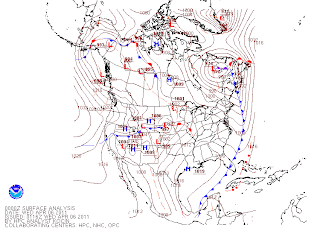
Right now birds displaced from the southern US are probably arriving on Newfoundland shores... but I'll have more to say about that tomorrow.
Oh and I almost forgot..added three new year birds today. Northern Fulmar, Ruffed Grouse and Thick-billed Murre. None of these are surprises. What was a surprise was the Great Egret that was reported. I did refind this bird. Unfortunately it was face down and not at all alive! Too bad, I hate seeing this happen,but such are the perils of migration. After the above system passes, I'd expect more Egrets!
 |
| Black-tailed Gull calling |
I'm hoping to add some video footage of this guy in a few days once I get that whole scene figured out ;/
While the BTGU is starting to brighten up some species such as Great Cormorant have been looking pretty snazzy for a while now. This species has managed to effectively elude my camera lens all winter until a couple days ago. I finally caught up to a nice alternate plumaged bird on the remains of a dilapidated wharf in the St.John's harbour. It was rewarding to finally get some good photo ops with these guys after chasing them around the harbour so much this winter but never connecting with them when there were in convenient locations.

 |
Along with the Shags another photo nemesis bird fell this winter- Wood Duck. Too be specific female Wood Duck. While the male of this species tends to garner most of the attention I find myself considerably more enamoured with the female.It lacks the riot of colors of the male Wood Duck, but makes up for that with a more subtle, less flamboyant beauty. I find myself especially drawn to the ye low orbital ring. That could just be me though, I have a thing for orbital rings. I won't get into that too much though or I'll ruin a future post. Anyway, you can see what I mean...
 |
Since I'm on the topic of birds making the switch from simple basic plumage to their more flash alternate dress, I would be inept if I failed to mention Black-headed Gull. About 75-100 BHGU's winter in St.John's each winter and every year local birders eagerly wait for them to acquire their black..eh hemm.. I mean brown heads. yea, Black-headed Gull is a bit of a misnomer. I guess they do look kinda black headed from a distance on an overcast day?? Anyway, I'll finish this quick post with a few BHGU's.


Looking ahead, I've got a number of things planned for future blog articles. I'm knee deep ina discussion about possible ways of separating nominate glaucoides Iceland Gulls from apparently <<< key word<<< pure, white winged Kumliens Gulls. I also eluded to a future post about orbital rings. However before all of that I'll have something to say about the weather and what we might have to look forward to.
Look at this weather map. This is happening right now...

Right now birds displaced from the southern US are probably arriving on Newfoundland shores... but I'll have more to say about that tomorrow.
Oh and I almost forgot..added three new year birds today. Northern Fulmar, Ruffed Grouse and Thick-billed Murre. None of these are surprises. What was a surprise was the Great Egret that was reported. I did refind this bird. Unfortunately it was face down and not at all alive! Too bad, I hate seeing this happen,but such are the perils of migration. After the above system passes, I'd expect more Egrets!
Saturday, March 19, 2011
2011 Newfoundland Winter Birding Summary
Since I'm writing a summary of Newfoundland winter birding, one would be tempted to think that winter was in fact over and in most places that would seems a logical conclusion. However, anyone who knows anything about Newfoundland weather knows logical is an adjective that simply doesn't apply.In fact, as I write this we are in the midst of a major snowfall. So while the calendar might say spring, the weather says winter!However, since techically it is spring,I guess this is a good time for a review of what has been one of the most exciting winter birding seasons in the history of Newfoundland birding.
Things got off with a bang on December 1st, when I discovered the provinces 2nd ever Black-tailed Gull at the sewage outfall in downtown St.John's.


later that same day a Slaty-backed Gull was discovered at Quidi Vidi lake. Slaty-backs are annual in St.John's now and along with California, St.John's is probably the msot reliable place to see this species outside of Alaska!! Just last week I discovered a second Slaty-backed Gull at the St.John's landfill, unofrtunately it was far away and behind a chain linked fence, but definitely a different bird based on it's bright yellow bill.

Rounding out the gull action on December 1st were a Yellow-legged Gull and an adult Thayer's Gull,to make for a 14 species gull day in the city.


About a week later the Lapwings started to arrive. During the last half of November through december Western Europe was experiencing extreme winter conditions with heavy snow fall and freezing conditions. In an effort to escape the sudden onset of winter many birds began to migrate from the Nothern UK ad other parts of western Europe into the southern most parts of the UL, France and probably Spain. When this happens we know there is potential for some birds such as Lapwings ( a common cold weather migrant) to turn up in Eastern Newfoundland. It`s hard to put a final tally on the number of Lappers we had in Newfoundland, but I`d guess it was at least 7-10 and probably many more that went unseen. Lapwings were seen off and on until late January.
As we were getting excited by the Lapwing arrivals news broke about a GREYLAG GOOSE that was photographed 180 miles off the NE coast of the island. This represents the second record for Newfoundland (the other on an offshore oil patform a couple years ago)and perhaps only the third for North America. Just a few days later Cliff Doran(Cape Race light keeper) found an Upland Sandpiper at Trepassey. UPSA is a big time rarity in Newfoundland and is practically unheard of in North America in December, aside from maybe a few records in teh some of the more southerly regions of the US. Over the next couple of week we kept ourselves busy looking for Lapwings when suddenly during the last few days of December Killdeer stared to arrive.
Now these were not migrants. Killdeers are not normally found within about 700+ miles of Newfoundland in winter, not to mention being uncommon in all seasons in the province. There were 56 seen on the Cape Race CBC alone. There must have been many hundreds in the province. Unfortunately all seem to have perished as of late February.
Just when we figured things wre about as good as they were going to get news broke on the Anna's Humingbird. Now, this was totally insane. The bird as visiting a hummingbird feeder in teh small community of Brownsdale, Trinty Bay, NW of St.John`s. Although this was completely shocking the record does make sense, since there has been a movement of Anna`s Hummingbirds into the east this winter, with several states and provinces getting their first or 2nd records including, Ontario, Quebec,Pennsylvania and North Carolina.
Photo by Jared Clarke
As January came to end we moved in the doldrums of winter. Well thats what would ahve happened ina normal year, but this year was anything but normal. February turned out to be one of the msot exciting months I've experienced in my dozen years of serious birding in Newfoundland. The month was kicked off with a Common Moorhen. After some careful evaluation it was determined that the bird was most likley a American Common Moohen, although we will never know for sure.

Photo by Jared Clarke
Hot on the heels of the Moorhen came the third North American mega-raity of the winter in the form of a Common Chaffinch. As I wrote earlier there are very few "good" records of Common Chaffinch in North America but we felt this bird was a genuine vagrant.

Not long after the Chaffinch, the Redwing reports started. Well there were actually 3 or 4 individuals, including one that seems to have hung around Portugal Cove South for about three weeks. There were probably more Redwings that went unseen. We generally find Redwing among Robin flocks feeding on Mountain Ash berries. This year there were essentially no Mountain Ash, or Dogberries as we call them, so the Robins were spread out feeding on Cranberries and Patridge berries on the barrens, making it much harder to sort through them and consequently more difficult to find vagrant Thrushes that might be hiding among them.


While Redwings are exciting birds and a huge rarity for most North American birders and in fact Newfoundland is about the the only place in North America where a birder would get more excited over a Long-eared Owl than a Redwing. That was exactly the case for myself and two other birders as we made our way home froma day birding on the southern Avalon in mid February. Long-eared owl is extremely rare in Newfoundland, with just three records. The bird we had in Ferryland was the first to have been seen in the wild by Newfoundland birders. The others were found injured.
Thw LEOW was a great bird and a major Newfoundland rarity, but not of great significance to North American birders, since they are relatively common across much of the continent. However, something much bigger was about to happen. Whil out looking for the LWOW on February 14th a local birder found a small group of three Snipe feeding in small puddle of open water. He photographed them briefly and moved on. It was not until he looked at the photos 6 days later that he realized that one of those Snipe was a JACK SNIPE!!!
Before news broke on the Jack Snipe Newfoundland birders were already in Snipe hunting mode because we had discovered seeral COMMON SNIPE. Common Snipe had been recorded in eastern North America only once previously and that was a single specimen collected in Labrador in 1927. Coincidentaly that year Newfoundland saw
1000's of Northern Lapwings, which were no doubt fleeing unusually bad weather in western Europe.


Aside from all the rarities there has been plenty of good winter birding in Newfoundland as well. We are startin to see good szed flocks of Common Eiders, including a few Kings. There are goodnumbers of Purple Sandpipers present and finches are beginning to stage a bit of an influx. Earlier in teh winter there were moderate numners of Dovekies t be found, which was nice after their inexplicable absence last winter. Throw in a bit of an ivasion of Boreal and Northern Saw-whet Owls into St.John's in February and that tops off a great winter of birding in one of North America's premier birding destinations!
NOTE I will be offering Newfoundland Winter birding tour next January, 2019. We will focus on rare gulls, finches and European rarities. Some highlight birds may include, Yellow-legged Gull, Common Snipe, Tufted Duck, Common Teal, Common Gull, Black-headed Gull, Eurasian Wigeon, Dovekie, Great Cormorant, King Eider (nice flocks of sea ducks in general), Pine Grosbeak, White-winged Crossbill, Boreal Chickadee, Willow Ptarmigan, Snowy Owl etc!
Things got off with a bang on December 1st, when I discovered the provinces 2nd ever Black-tailed Gull at the sewage outfall in downtown St.John's.


later that same day a Slaty-backed Gull was discovered at Quidi Vidi lake. Slaty-backs are annual in St.John's now and along with California, St.John's is probably the msot reliable place to see this species outside of Alaska!! Just last week I discovered a second Slaty-backed Gull at the St.John's landfill, unofrtunately it was far away and behind a chain linked fence, but definitely a different bird based on it's bright yellow bill.

Rounding out the gull action on December 1st were a Yellow-legged Gull and an adult Thayer's Gull,to make for a 14 species gull day in the city.


About a week later the Lapwings started to arrive. During the last half of November through december Western Europe was experiencing extreme winter conditions with heavy snow fall and freezing conditions. In an effort to escape the sudden onset of winter many birds began to migrate from the Nothern UK ad other parts of western Europe into the southern most parts of the UL, France and probably Spain. When this happens we know there is potential for some birds such as Lapwings ( a common cold weather migrant) to turn up in Eastern Newfoundland. It`s hard to put a final tally on the number of Lappers we had in Newfoundland, but I`d guess it was at least 7-10 and probably many more that went unseen. Lapwings were seen off and on until late January.
As we were getting excited by the Lapwing arrivals news broke about a GREYLAG GOOSE that was photographed 180 miles off the NE coast of the island. This represents the second record for Newfoundland (the other on an offshore oil patform a couple years ago)and perhaps only the third for North America. Just a few days later Cliff Doran(Cape Race light keeper) found an Upland Sandpiper at Trepassey. UPSA is a big time rarity in Newfoundland and is practically unheard of in North America in December, aside from maybe a few records in teh some of the more southerly regions of the US. Over the next couple of week we kept ourselves busy looking for Lapwings when suddenly during the last few days of December Killdeer stared to arrive.
Now these were not migrants. Killdeers are not normally found within about 700+ miles of Newfoundland in winter, not to mention being uncommon in all seasons in the province. There were 56 seen on the Cape Race CBC alone. There must have been many hundreds in the province. Unfortunately all seem to have perished as of late February.
Just when we figured things wre about as good as they were going to get news broke on the Anna's Humingbird. Now, this was totally insane. The bird as visiting a hummingbird feeder in teh small community of Brownsdale, Trinty Bay, NW of St.John`s. Although this was completely shocking the record does make sense, since there has been a movement of Anna`s Hummingbirds into the east this winter, with several states and provinces getting their first or 2nd records including, Ontario, Quebec,Pennsylvania and North Carolina.

Photo by Jared Clarke
As January came to end we moved in the doldrums of winter. Well thats what would ahve happened ina normal year, but this year was anything but normal. February turned out to be one of the msot exciting months I've experienced in my dozen years of serious birding in Newfoundland. The month was kicked off with a Common Moorhen. After some careful evaluation it was determined that the bird was most likley a American Common Moohen, although we will never know for sure.

Photo by Jared Clarke
Hot on the heels of the Moorhen came the third North American mega-raity of the winter in the form of a Common Chaffinch. As I wrote earlier there are very few "good" records of Common Chaffinch in North America but we felt this bird was a genuine vagrant.

Not long after the Chaffinch, the Redwing reports started. Well there were actually 3 or 4 individuals, including one that seems to have hung around Portugal Cove South for about three weeks. There were probably more Redwings that went unseen. We generally find Redwing among Robin flocks feeding on Mountain Ash berries. This year there were essentially no Mountain Ash, or Dogberries as we call them, so the Robins were spread out feeding on Cranberries and Patridge berries on the barrens, making it much harder to sort through them and consequently more difficult to find vagrant Thrushes that might be hiding among them.


While Redwings are exciting birds and a huge rarity for most North American birders and in fact Newfoundland is about the the only place in North America where a birder would get more excited over a Long-eared Owl than a Redwing. That was exactly the case for myself and two other birders as we made our way home froma day birding on the southern Avalon in mid February. Long-eared owl is extremely rare in Newfoundland, with just three records. The bird we had in Ferryland was the first to have been seen in the wild by Newfoundland birders. The others were found injured.
Thw LEOW was a great bird and a major Newfoundland rarity, but not of great significance to North American birders, since they are relatively common across much of the continent. However, something much bigger was about to happen. Whil out looking for the LWOW on February 14th a local birder found a small group of three Snipe feeding in small puddle of open water. He photographed them briefly and moved on. It was not until he looked at the photos 6 days later that he realized that one of those Snipe was a JACK SNIPE!!!
Before news broke on the Jack Snipe Newfoundland birders were already in Snipe hunting mode because we had discovered seeral COMMON SNIPE. Common Snipe had been recorded in eastern North America only once previously and that was a single specimen collected in Labrador in 1927. Coincidentaly that year Newfoundland saw
1000's of Northern Lapwings, which were no doubt fleeing unusually bad weather in western Europe.


Aside from all the rarities there has been plenty of good winter birding in Newfoundland as well. We are startin to see good szed flocks of Common Eiders, including a few Kings. There are goodnumbers of Purple Sandpipers present and finches are beginning to stage a bit of an influx. Earlier in teh winter there were moderate numners of Dovekies t be found, which was nice after their inexplicable absence last winter. Throw in a bit of an ivasion of Boreal and Northern Saw-whet Owls into St.John's in February and that tops off a great winter of birding in one of North America's premier birding destinations!
NOTE I will be offering Newfoundland Winter birding tour next January, 2019. We will focus on rare gulls, finches and European rarities. Some highlight birds may include, Yellow-legged Gull, Common Snipe, Tufted Duck, Common Teal, Common Gull, Black-headed Gull, Eurasian Wigeon, Dovekie, Great Cormorant, King Eider (nice flocks of sea ducks in general), Pine Grosbeak, White-winged Crossbill, Boreal Chickadee, Willow Ptarmigan, Snowy Owl etc!
Friday, March 18, 2011
Tufted X Ring-necked Duck Hybrid
One of the benefits of doing a big year, is it gets you to places you would otherwise not go. A few days ago I made the 160 km trip to Clarenville ( stopping in Arnold's Cove on the way) to add Harlequin Duck and Gadwall to my yer list. Both are birds that I will likely see again later in the year, but in a big year a bird in the hand etc etc....
Anyway, while I was looking for the Harlequin Duck in Clarenville I came across this hybrid Tufted X Ring-necked Duck.

Notice the intermediate features, such as the stubby tuft, the RNDU style white around the base of the bill and at the tip and the gray washed flanks, which are gleaming white in adult male TUDU.

Compare to this adult Tufted Duck
Also worth noting is the wing pattern,which is intermediate between the two species.

TUDU X RNDU Hybrid showing primary pattern intermediate between the two species.
Normally TUDU's show bright white secondaries, with the white extending well into the outer primaries. While RNDU shows greyish primaries and secondaries. When you combine the two it seems you get a pattern similar to that seen in Lesser Scaup,with bright white restricted mainly to the secondaries. Although note in this hybrid the first few primaries show some white as well.
This individual was found a couple of months ago by Bruce Mactavish and I had completely forgotten about it existence,so it was a nice surprise when I saw it. This is a rare hybrid on this side of the Atlantic and is more often seen in Europe. However, over the course of te last decade the number of wintering Tufted Ducks in Newfoundland has increased dramatically, with 35+ in St.John's alone, at one point this winter. There are probably;y that many again, spread out over the rest of the island. If these numbers continue to grow, I wouldn't be surprised to see more of these hybrids. Equally likely and a more appealing option would be the first discovery of Tufted Ducks breeding in Newfoundland. It would seem to make sense to stick around rather than fly all the way back to Iceland each spring. Black-headed Gulls started out kind of like this and they have now established a small breeding colony in western Newfoundland, so maybe Tufted Duck will be next!?
Anyway, while I was looking for the Harlequin Duck in Clarenville I came across this hybrid Tufted X Ring-necked Duck.

Notice the intermediate features, such as the stubby tuft, the RNDU style white around the base of the bill and at the tip and the gray washed flanks, which are gleaming white in adult male TUDU.

Compare to this adult Tufted Duck
Also worth noting is the wing pattern,which is intermediate between the two species.

TUDU X RNDU Hybrid showing primary pattern intermediate between the two species.
Normally TUDU's show bright white secondaries, with the white extending well into the outer primaries. While RNDU shows greyish primaries and secondaries. When you combine the two it seems you get a pattern similar to that seen in Lesser Scaup,with bright white restricted mainly to the secondaries. Although note in this hybrid the first few primaries show some white as well.
This individual was found a couple of months ago by Bruce Mactavish and I had completely forgotten about it existence,so it was a nice surprise when I saw it. This is a rare hybrid on this side of the Atlantic and is more often seen in Europe. However, over the course of te last decade the number of wintering Tufted Ducks in Newfoundland has increased dramatically, with 35+ in St.John's alone, at one point this winter. There are probably;y that many again, spread out over the rest of the island. If these numbers continue to grow, I wouldn't be surprised to see more of these hybrids. Equally likely and a more appealing option would be the first discovery of Tufted Ducks breeding in Newfoundland. It would seem to make sense to stick around rather than fly all the way back to Iceland each spring. Black-headed Gulls started out kind of like this and they have now established a small breeding colony in western Newfoundland, so maybe Tufted Duck will be next!?
Monday, March 14, 2011
Gyrfalcon Dreams and Ecstasy in Ivory
Well it's been about ten days since I started my Gyr search and I'm still Gyrless!Today aside from looking for Gyrs I went to look for a single King Eider that has been associating with over 3000 Common Eider. When I got to the location the birds we way off shore. I got to looking around the area. I was perched atop a high cliff face. Opposite me were steep cliffs that would soon be covered in nesting Black-legged Kittiwakes, this was a great spot for a Gyrfalcon- we know they've been seen here before.
Anyway, the point of all this is I finally realized that if the Gyrs aren't going to come to me, then I'm going to go to them and so it was decided. I'm going to make the 1050 km drive to the northernmost tip of Nefoundland. This is not a place where you see a random Gyrfalcon, it is within their regular winter range. They are seen there this time of year perched on cliff faces waiting for an opportunity to take some unsuspecting gull or duck. I saw photos taken last year of a Gyr taking an Ivory Gull from this exact location. If I see that, it will be the closest thing to a religious experience I have ever had. To see that scene play out is the pinnacle of birding. I was supposed to be there, but I couldn't make it at the time and I've regretted it ever since.
So, I'll be departing St.John's early on the morning of March 24th, hopefully with a few more people, since I've offered this as tour. With any luck early on the morning of the 25th we'll have our first Gyr,hopefully to be followed by several others.
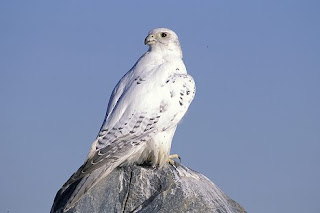
Internet Photo

I can see it happening like this. A white morph Gyr perched on a rockface with snow covered cliffs in the background. I'm almost salivating , just thinking about it.I do not know the artist but I figure if I'm going to use the painting I should link to his site. It can be purchased here.
Ok, so it's obvious I love Gyrs, but you know that's only half the equation. There is only one bird that for me can rival Gyrfalcon in it's mystic appeal to birders- Ivory Gull. Bruce Mactavish said of Ivory Gull "its the only bird that looks better every time you see it". Ivory Gull will not be a guarentee on my trip and Gyrfalcon is probably more likely. However, I have reason to be optimistic about the possibilities of seeing these Arctic ghosts.

Above Photos property of Bruce Mactavish
Starting around March 18th a pretty strong weather system originating in northern Canada is going to move over northern Newfoundland and looking at the isobars it looks like there is going to be some fairly strong northerly winds associated with ths system. Ivory Gulls loungin on the pack ice in the Labrador sea could be encouraged to move south to northern Newfoundland.

Note the tightly packed isobars over Newfondland bringing winds from the Labrador Sea and hopefully Ivory Gulls to Northern Newfoundland.
Things calm down for a couple days then another system moves in from the southern US and looks like it will itensify offshore, growing as it approaches NL. Looking at the maps, it looks like this system is big and might continue north. If it does it will generate more fierce winds with a northern component- Again good for IVGU and GYR!

I'll end this posting with a series of excellent photos taken by Bruce Mactavish in late February 2010 at the tail end of an Ivory Gull invasion into Northern Newfoundland. Well over 100 Ivory Gulls were seen in that week. I'm not asking for that many, a few will do. Heck even a great experience with one!


All IVGU photos courtesy of Bruce Mactavish
Anyway, the point of all this is I finally realized that if the Gyrs aren't going to come to me, then I'm going to go to them and so it was decided. I'm going to make the 1050 km drive to the northernmost tip of Nefoundland. This is not a place where you see a random Gyrfalcon, it is within their regular winter range. They are seen there this time of year perched on cliff faces waiting for an opportunity to take some unsuspecting gull or duck. I saw photos taken last year of a Gyr taking an Ivory Gull from this exact location. If I see that, it will be the closest thing to a religious experience I have ever had. To see that scene play out is the pinnacle of birding. I was supposed to be there, but I couldn't make it at the time and I've regretted it ever since.
So, I'll be departing St.John's early on the morning of March 24th, hopefully with a few more people, since I've offered this as tour. With any luck early on the morning of the 25th we'll have our first Gyr,hopefully to be followed by several others.

Internet Photo

I can see it happening like this. A white morph Gyr perched on a rockface with snow covered cliffs in the background. I'm almost salivating , just thinking about it.I do not know the artist but I figure if I'm going to use the painting I should link to his site. It can be purchased here.
Ok, so it's obvious I love Gyrs, but you know that's only half the equation. There is only one bird that for me can rival Gyrfalcon in it's mystic appeal to birders- Ivory Gull. Bruce Mactavish said of Ivory Gull "its the only bird that looks better every time you see it". Ivory Gull will not be a guarentee on my trip and Gyrfalcon is probably more likely. However, I have reason to be optimistic about the possibilities of seeing these Arctic ghosts.

 |
Above Photos property of Bruce Mactavish
Starting around March 18th a pretty strong weather system originating in northern Canada is going to move over northern Newfoundland and looking at the isobars it looks like there is going to be some fairly strong northerly winds associated with ths system. Ivory Gulls loungin on the pack ice in the Labrador sea could be encouraged to move south to northern Newfoundland.

Note the tightly packed isobars over Newfondland bringing winds from the Labrador Sea and hopefully Ivory Gulls to Northern Newfoundland.
Things calm down for a couple days then another system moves in from the southern US and looks like it will itensify offshore, growing as it approaches NL. Looking at the maps, it looks like this system is big and might continue north. If it does it will generate more fierce winds with a northern component- Again good for IVGU and GYR!

I'll end this posting with a series of excellent photos taken by Bruce Mactavish in late February 2010 at the tail end of an Ivory Gull invasion into Northern Newfoundland. Well over 100 Ivory Gulls were seen in that week. I'm not asking for that many, a few will do. Heck even a great experience with one!


All IVGU photos courtesy of Bruce Mactavish
Subscribe to:
Posts (Atom)
Popular Posts
-
 Let me preface this post by saying this is not meant to be a treatise on the identification of Yellow-legged Gulls,there has already been lo...
 -
 **Note This blog is posted in an effort to illicit responses from people with experience identifying silent Wood Pewees in the field. A g...
 -
 The purpose of this blog is purely to provide a large collection of photos of American Herring Gull wing tips. All photos are of adult birds...
 -
 This is just a short article in response to a recent discussion on the North American Gulls facebook group regarding ageing Glaucous Gulls a...
 -
 Discussion of the first record of Common Snipe for Newfoundland A couple of days ago I got a photo of a pale Snipe found by Bruce Mactavi...