This is an article I've been threatening to write for some time. So now finally, at 12:01 tonight I decided to sit down get to work. Before I get into any discussion I should advise that I've never been to Greenland or Iceland and have no real life experience with g.glaucoides in their true range.So, feel free to take what I say with a grain of salt, should you decide to keep reading at all.Having said that I've seen a hell of a lot of Kumlien's Iceland Gulls, and have a good feeling for the limits of variation within that subspecies, if you want to call it that. Over the years, I have looked at every photo of g.glaucoides I could get my hands on, and and photographed a number of individuals in Newfoundland, some of which I will share in this article.
Throughout the course of this article I will discuss the variation in Kumlien's Iceland Gull and compare that to (what I think of) g.Glaucoides. I will discuss criteria for separating these two subspecies (based on a Newfoundland, or perhaps just my, perspective). I will limit my discussion to adult birds only,since I have not seen any reliable way of separating juveniles and fist winter birds. As birds get into their second, and especially third winter, they become easier to separate but as I said, I will concentrate on adult birds. I will give particular attention to those Kumlien's Gulls that could present a possible caveat for those wishing to identify g.glaucoides. Alternately, this may be of use to European birders, who endeavor to identify out of range Kumlien's Gulls.
Newfoundland seems to host the lion share of the winter population of Kumlien's Gulls.While they are very well represented throughout the Canadian Maritimes,with some into the mid west and Great Lakes and down the eastern seaboard into New England, I doubt there is anywhere else on earth one could witness the numbers and diversity of Kumlien's Gulls that we see in St.John's, Newfoundland in winter. This combined with the fact that I just don't have much else to do in winter has afforded me the opportunity to gain an intimate knowledge of Kumlien's Gulls over the last 10-12 years.
Over that time I've witnessed a number of characters that seem to separate Kumlien's from g.glaucoides. Among the more important of these are,
1)
mantle shade- Kumliens slightly paler than smithsonianus HERG while g.glaucoides is as pale a Glaucous Gull or paler.
2)
eye color- Kumliens can vary from very pale to very dark but ALWAYS has at least some dark peppering in the iris while g.glaucoides ALWAYS has a fully pale eye without dark peppering ranging pale to creamy yellow reminiscent of Glaucous Gull.( I'm open to revising this statement, if someone can provide me with conflicting evidence)
3)
Primary coloration- Kumliens varies from having dark marking on as many as 6 outer primaries (though usually 4) to pure white wing tips with dark pigment restricted to the outer web of p10 (sometimes very faint) g.glaucoides never has dark markings or any kind in the wings as adult-- always pure white tips and lacking any dark marbling in the outer web of p 10.
4)
structure- On average Kumlien's seem to appear larger billed,with less rounded head. Appear more menacing and bulky overall. The smallest g.glaucoides can appear very dainty with quite small, Dove-like heads.
While there may be other differences,I believe any Iceland combining all of the above characters, one way or the other, can be safely assigned to subspecies. Any Iceland Gull that appears extremely dainty, with a clear yellow eye, pure white wing tips and mantle color matching GLGU is probably, if not certainly a g.glaucoides. At times there are birds that have 3 of 4 of the above characters and are suggestive of g.glaucoides but I choose to leave these birds unidentified.
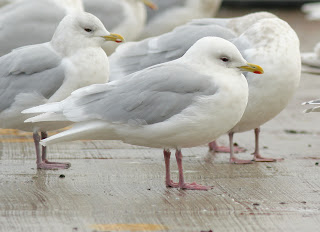 Example of g.glaucoides- like Kumlien's Gull. Structurally very reminiscent of g.glaucoides with smallish bill, rounded head, creating a dainty impression. Wings apparently pure white,lacking any dark markings. However, note mantle coloration same as surrounding Kumliens Gulls and dark eye. What does this mean??
MANTLE SHADE
Example of g.glaucoides- like Kumlien's Gull. Structurally very reminiscent of g.glaucoides with smallish bill, rounded head, creating a dainty impression. Wings apparently pure white,lacking any dark markings. However, note mantle coloration same as surrounding Kumliens Gulls and dark eye. What does this mean??
MANTLE SHADE
Kumliens Gulls have a mantle shade just lighter than smithsonianus Herring Gull, but noticeably darker than any Glaucous Gull. In direct comparison with glaucoides Kumlien's appears at least a shade darker. See photos below.
 |
| Add caption |
Presumed g.glaucoides,St.John's, Newfoundland,December. Compare to Herring Gull on left and Kumliens Gulls on right and behind. Also note similarity in Kumlien's and Herring Gull mantle shade. Note this individual shows all four key features mentioned above, pale mantle, pure, pale eye,lacking dark peppering, pure white wings. Structurally this bird was a little bulky, so probably a male.
 Presumed g.glaucoides, late January, St.John's, Newfoundland. Compare with Kumlieni to the left. There is less contrast between the primaries and mantle in glaucoides then even the whitest winged kumlieni.
EYE COLOR
Presumed g.glaucoides, late January, St.John's, Newfoundland. Compare with Kumlieni to the left. There is less contrast between the primaries and mantle in glaucoides then even the whitest winged kumlieni.
EYE COLOR
Eye color is among the most variable of all Kumlien's traits. However, in my experience there are limits. There seem to be a couple of potential rules among the variability.
1) While KUM iris' can appear completely dark to completely pale,there is ALWAYS at least some dark peppering in the iris.
2) In adult g.glaucoides there is NEVER a large amount of dark peppering in the iris. The adult eye color is usually a clear creamy yellow and mostly lacking the more amber and golden tones shown by pale eyed Kumlien's. From what I can see most of the time it lacks any dark spots in the iris whatsoever,but perhaps some can show a few dark specs.
Below are a series of photos displaying the range of eye color possible in Kumlien's Gull with a few g.glaucoides thrown in.


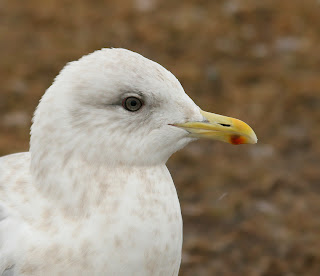


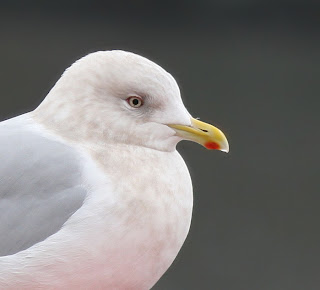
 3rd winter g.glaucoides,Newfoundland,January. Note the creamy-yellow color lacking dark peppering.

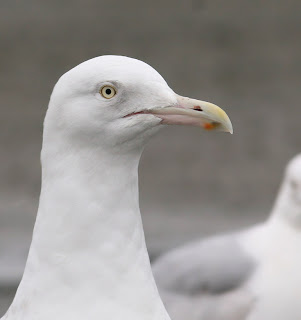 Adult Glaucous Gull, Newfoundland, January. Note similarity to the g.glaucoides above.
PRIMARY COLORATION
Adult Glaucous Gull, Newfoundland, January. Note similarity to the g.glaucoides above.
PRIMARY COLORATION
This is actually quite straightforward. While Kumlien's Gull can pretty much range from primary patters closely matching those of Thayer's Gull to almost pure white winged as in g.glaucoides. The whitest winged Kumliens have only a very small amount of dark coloration (sometimes limited to light gray marbling) on P10.
In contrast to Kumlien's, adult g.glaucoides NEVER has any dark coloration in the primaries.
Three dark-winged Kumlien's Gull's.


 White-winged Kumlien's Gulls
While the above birds would never be mistaken for g.glaucoides there are some more confusing individuals. While some Kum's have dark marking on the outer 5-6 primaries ( usually grayish) there are others that can appear completely pure, white-winged. When you find an Iceland Gull that seems to lack any dark markings in the primaries, its important to remember the other criteria that distinguish Kumlien's and g.glaucoides, such as mantle shade and eye color. Then, if possible scrutinize the wings as closely as possible looking especially for any signs of darker markings on p10,mainly on the lower 2/3rd's of the feather in the outer web. Some examples of pale winged Kumlien's below.


 STRUCTURE
Structurally Kumlien's can be quite variable. In general it has a smallish billed and more round headed (less sloping forehead)appearance when compared to Herring Gull. This creates a much more gentle expression and a more overall dainty feel to the bird. Among Iceland Gulls g.glaucoides tend to have an even more dainty appearance than Kumliens, often being shorter bill and having a steeper forehead. I don't have a complete understanding of the structural variability in g.glaucoides, but the individuals I've seen in Newfoundland have all been very short-billed round headed individuals. I'm sure there is much overlap with Kumlien's so this is just an accessory feature to be used along with mantle shade, eye color and primary coloration.
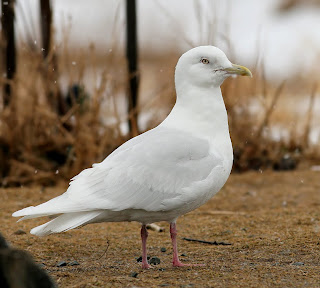
g.glaucoides Iceland Gull February, Newfoundland

g.glaucoides, Iceland Gull, January Newfoundland.
g.glaucoides Iceland Gull, January, Newfoundland. Note the steep forehead and very rounded crown, along with short bill creating gentle expression.
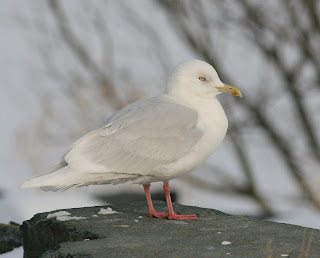
This article is not meant to be a definitive work on the separation of these two subspecies, but rather a discussion of some of my observations here in Newfoundland. As I continue to get a better grasp on the potential variation that exists in g.glaucoides I hope to update this article.We're still learning more about these birds every day!For now I'll leave you with one last photo that serves to accentuate the extreme variation found within this species.
 Two Kumlien's Gulls, February, Newfoundland. These two individuals nicely display the extreme variation in primary coloration that exists within this species.
I am thrilled to be able to provide educational and entertaining content. However, these articles are very time consuming to write. If possible please considering subscribing to the blog with a very small monthly fee via the subscribe button. This will help to cover costs of website maintenance and all the other expenses that go into producing the content. Whether you subscribe or not you will still have access to all the content, the small subscription fee is just a means of showing your support. Thank you!


