Showing posts with label Yellow-legged Gull. Show all posts

Friday, February 22, 2019

Saving a Yellow-legged Gull Photo Op!

This is a story about an encounter I had with a Yellow-legged Gull many years ago ( 8 years ago to be exact). For the unfamiliar, Yellow-legged Gull is a much sought after Gull species in North America. There are not that many records and most of the good ones are from here in St.John's, where it has been mostly annual (sometimes multiple individuals) for almost 20 years.

Our particular brand of Yellow-legged Gull are thought to originate in Azores, which is approximately 2500 km's to our east. This is not meant to be an ID piece, so I won't get into details of  why our bird's are thought to be Azorean, but if you are curious, feel free to message me or comment here and I'm happy to explain.

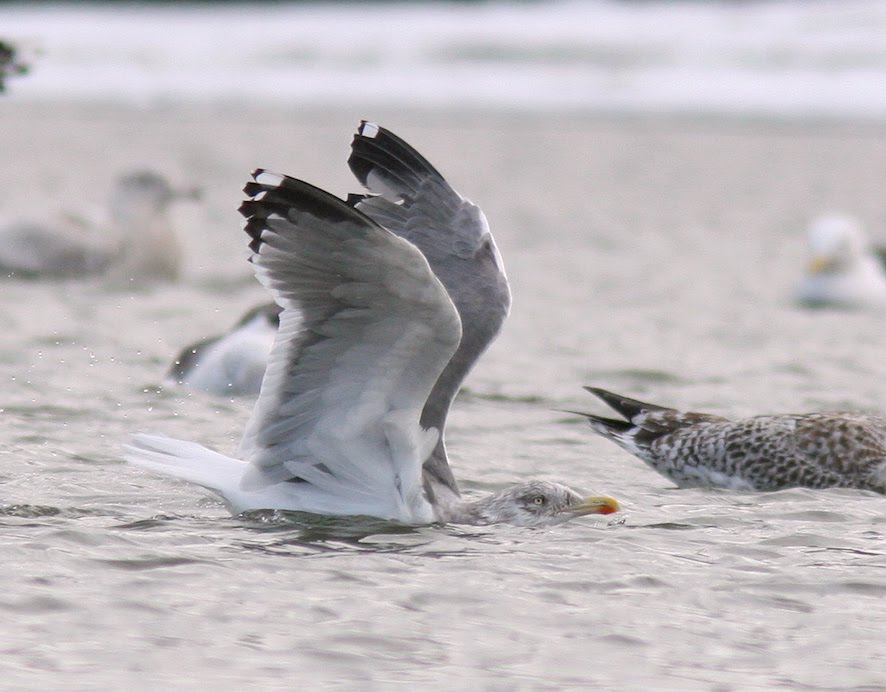
If you are a dedicated Gull watcher and know what to look for, most winters, you can get some good looks at Yellow-legged Gull in St.John's. However, good looks don't always equate to good photos. While I have seen Yellow-legged Gull very well many times and have logged many hours of combined observation time over the years, rarely do you see these birds up close an personal. It's even more unusual to get good flight shots, and even rarer still to get an opportunity for that classic (head forward, wings raise vertically) stretching pose. Personally, this is one of my favorite poses to capture in photos and getting the chance to get a Yellow-legged Gull in this pose, at close range, is somewhat akin to winning the rare bird photography lottery.

One afternoon I was doing my regular rounds, Quidi Vidi Lake, Pier 17 sewer outflow and lastly Harvey Wharf (sadly, the latter two locations are gone!). When I got to Harvey Wharf, I was looking through the Gulls and I could hardly believe my eyes, there was a (the) Yellow-legged Gull. While it has been a known bird, it wasn't seen in this spot very often. It was not real close, but closer than normal. Then just as I get my camera in position a flush, and all the Gulls lift off. I figured this was it for my Yellow-legged Gull photo ops. Amazingly, the bird circled back and landing right in front of me! At the time I was using a Canon 300mm f4 and a 1.4 extender, there was no zoom option, just a static magnification. I could hardly believe my luck. I started blasting off shots of the standing bird, not even considering that it might do anything interesting. Then I noticed it was starting to stretch. The bird was so close I could hardly fit it in the frame as it was (not usually an issue!), I knew I would not be able to fit the bird and it's stretched wings in the frame. However, there was a solution. I shot off frames of the bird, then adjusted slightly to get the wings, the photos below were the result.

YLGU stretching, late Dec, 2011, St.John's, NL

The rest of the YLGU, stretching, late Dec 2011, St.John's, NL

Well, what was I going to do with this.I had half a bird, posts, boards etc all over the place. Seemingly, not the makings of a good photo. However, it could be saved! While I am not usually one to spend a lot of time on post processing, I felt it was justified in this case. So I went about stitching the photos together and cloning out the distracting elements from the foreground and background. The result is the photo below.

YLGU stretching, late Dec, 2011, St.John's NL

After some effort in photo shop I was quite pleased with the result. To this day I have never has an opportunity like this again.

Friday, June 15, 2018

Old Friends Reunite!

I was looking through some old photos and came across one that I hadn't seen in a long time of two Yellow-legged Gulls, photographed together at Quidi Viki Lake, in St.John's, Newfoundland in early October 2011. While Yellow-legged Gull is a major rarity in North America, it has become somewhat of a Newfoundland winter specialty over the last 15 years or so, with one or more birds usually present from September- March. On this particular day I located two Yellow-legged Gulls together among a mixed flock of Gulls loafing in a ball field near Quidi Vidi Lake. While I was super excited  to see them, you can imagine their surprise when they saw each other some 2500+ km's from their Azores home! My fiance added the caption at the time.I thought it was amusing and figured I'd share it :)
Two Yellow-legged Gulls together in Newfoundland
YLGU's, presumably of Azorean origin. The individual on the right is perhaps a little more typical of fall birds with a more extensive hood of streaks. They are completely white headed by Christmas.

Saturday, March 19, 2011

2011 Newfoundland Winter Birding Summary

Since I'm writing a summary of Newfoundland winter birding, one would be tempted to think that winter was in fact over and in most places that would seems a logical conclusion. However, anyone who knows anything about Newfoundland weather knows logical is an adjective that simply doesn't apply.In fact, as I write this we are in the midst of a major snowfall. So while the calendar might say spring, the weather says winter!However, since techically it is spring,I guess this is a good time for a review of what has been one of the most exciting winter birding seasons in the history of Newfoundland birding.

Things got off with a bang on December 1st, when I discovered the provinces 2nd ever Black-tailed Gull at the sewage outfall in downtown St.John's.


later that same day a Slaty-backed Gull was discovered at Quidi Vidi lake. Slaty-backs are annual in St.John's now and along with California, St.John's is probably the msot reliable place to see this species outside of Alaska!! Just last week I discovered a second Slaty-backed Gull at the St.John's landfill, unofrtunately it was far away and behind a chain linked fence, but definitely a different bird based on it's bright yellow bill.


Rounding out the gull action on December 1st were a Yellow-legged Gull and an adult Thayer's Gull,to make for a 14 species gull day in the city.


About a week later the Lapwings started to arrive. During the last half of November through december Western Europe was experiencing extreme winter conditions with heavy snow fall and freezing conditions. In an effort to escape the sudden onset of winter many birds began to migrate from the Nothern UK ad other parts of western Europe into the southern most parts of the UL, France and probably Spain. When this happens we know there is potential for some birds such as Lapwings ( a common cold weather migrant) to turn up in Eastern Newfoundland. It`s hard to put a final tally on the number of Lappers we had in Newfoundland, but I`d guess it was at least 7-10 and probably many more that went unseen. Lapwings were seen off and on until late January.

As we were getting excited by the Lapwing arrivals news broke about a GREYLAG GOOSE that was photographed 180 miles off the NE coast of the island. This represents the second record for Newfoundland (the other on an offshore oil patform a couple years ago)and perhaps only the third for North America. Just a few days later Cliff Doran(Cape Race light keeper) found an Upland Sandpiper at Trepassey. UPSA is a big time rarity in Newfoundland and is practically unheard of in North America in December, aside from maybe a few records in teh some of the more southerly regions of the US. Over the next couple of week we kept ourselves busy looking for Lapwings when suddenly during the last few days of December Killdeer stared to arrive.

Now these were not migrants. Killdeers are not normally found within about 700+ miles of Newfoundland in winter, not to mention being uncommon in all seasons in the province. There were 56 seen on the Cape Race CBC alone. There must have been many hundreds in the province. Unfortunately all seem to have perished as of late February.

Just when we figured things wre about as good as they were going to get news broke on the Anna's Humingbird. Now, this was totally insane. The bird as visiting a hummingbird feeder in teh small community of Brownsdale, Trinty Bay, NW of St.John`s. Although this was completely shocking the record does make sense, since there has been a movement of Anna`s Hummingbirds into the east this winter, with several states and provinces getting their first or 2nd records including, Ontario, Quebec,Pennsylvania and North Carolina.
Photo by Jared Clarke

As January came to end we moved in the doldrums of winter. Well thats what would ahve happened ina normal year, but this year was anything but normal. February turned out to be one of the msot exciting months I've experienced in my dozen years of serious birding in Newfoundland. The month was kicked off with a Common Moorhen. After some careful evaluation it was determined that the bird was most likley a American Common Moohen, although we will never know for sure.


Photo by Jared Clarke

Hot on the heels of the Moorhen came the third North American mega-raity of the winter in the form of a Common Chaffinch. As I wrote earlier there are very few "good" records of Common Chaffinch in North America but we felt this bird was a genuine vagrant.


Not long after the Chaffinch, the Redwing reports started. Well there were actually 3 or 4 individuals, including one that seems to have hung around Portugal Cove South for about three weeks. There were probably more Redwings that went unseen. We generally find Redwing among Robin flocks feeding on Mountain Ash berries. This year there were essentially no Mountain Ash, or Dogberries as we call them, so the Robins were spread out feeding on Cranberries and Patridge berries on the barrens, making it much harder to sort through them and consequently more difficult to find vagrant Thrushes that might be hiding among them.


While Redwings are exciting birds and a huge rarity for most North American birders and in fact Newfoundland is about the the only place in North America where a birder would get more excited over a Long-eared Owl than a Redwing. That was exactly the case for myself and two other birders as we made our way home froma day birding on the southern Avalon in mid February. Long-eared owl is extremely rare in Newfoundland, with just three records. The bird we had in Ferryland was the first to have been seen in the wild by Newfoundland birders. The others were found injured.

Thw LEOW was a great bird and a major Newfoundland rarity, but not of great significance to North American birders, since they are relatively common across much of the continent. However, something much bigger was about to happen. Whil out looking for the LWOW on February 14th a local birder found a small group of three Snipe feeding in small puddle of open water. He photographed them briefly and moved on. It was not until he looked at the photos 6 days later that he realized that one of those Snipe was a JACK SNIPE!!!

Before news broke on the Jack Snipe Newfoundland birders were already in Snipe hunting mode because we had discovered seeral COMMON SNIPE. Common Snipe had been recorded in eastern North America only once previously and that was a single specimen collected in Labrador in 1927. Coincidentaly that year Newfoundland saw
1000's of Northern Lapwings, which were no doubt fleeing unusually bad weather in western Europe.


Aside from all the rarities there has been plenty of good winter birding in Newfoundland as well. We are startin to see good szed flocks of Common Eiders, including a few Kings. There are goodnumbers of Purple Sandpipers present and finches are beginning to stage a bit of an influx. Earlier in teh winter there were moderate numners of Dovekies t be found, which was nice after their inexplicable absence last winter. Throw in a bit of an ivasion of Boreal and Northern Saw-whet Owls into St.John's in February and that tops off a great winter of birding in one of North America's premier birding destinations!

NOTE I will be offering Newfoundland Winter birding tour next January, 2019. We will focus on rare gulls, finches and European rarities. Some highlight birds may include, Yellow-legged Gull, Common Snipe, Tufted Duck, Common Teal, Common Gull, Black-headed Gull, Eurasian Wigeon, Dovekie, Great Cormorant, King Eider (nice flocks of sea ducks in general), Pine Grosbeak, White-winged Crossbill, Boreal Chickadee, Willow Ptarmigan, Snowy Owl etc!


Tuesday, March 1, 2011

Separation of YLGU and LBBG X HERG Hybrids

Since the last post was quite long I thought it better to devote a separate post for this topic. In this post I will cover the separation of Yellow-legged Gull from the very similar Herring X Lesser-Black-backed Gull hybrids. For the purposes of this discussion I will be focusing only on adult birds and the comparison will be made between atlantis subspecies Yellow-legged Gulls and Herring (unknown ssp) X Lesser-Black-backed Gull (presumed Graellsi)hybrids.

This problem of HERG X LBBG hybrids is becoming increasingly relevant as the numbers of LBBG's in North America continue to increase. We have already had several instances of hybridization between graellsi LBBG's and Smithsonianus HERG's. A very well documented example and some nice discussion by Kirk Zufelt can be found here The Expansion of LBBG Some discussion about the discovery of a LBBG paired with a HERG on Appledore Island NH an be found here Appledore Gull As well,there have been several documented insyances of suspect LBBG X HERG hybrids getting friendly with Herring Gulls in Labrador,but no evidence of mating. The issue of HERG X LBBG hybrids is problematic enough, when you consider what a LBBG X HERG paired with a HERG would produce....well I don't even want to think about it!

Anyway, I'm getting off track , the purpose of this article is to discuss the separation of atlantis YLGU's from HERG X LBBG hybrids, so lets get started on that. I'm going to compare Yellow-legged Gull and HERG X LBBG hybrids based on their main points of separation, namely, mantle color, winter head streaking, bare parts coloration and wing tip pattern. I will not make any inferences about moult timing, since for hybrids,this is at best poorly understood,but from my experience most HERG X LBBG hybrids seem to follow a predominantly LBBG type moult schedule.

Mantle Color

This is often the first thing I look for when searching for YLGU's among mixed gull flocks in St.John's. When I'm guiding and I can't find a YLGU for my client I will sometimes seek out a LBBGXHERG hybrid to show them the mantle color we are looking for. This works great because atlantis YLGU's and HERGXLBBG hybrids seem to have identical mantle shades.

Lesser Black-backed Gull X herring Gull hybrid Newfoundland

Not surpriseingly hybrid HERG XLBBG's have a mantle shade that is pretty much perfectly intermediate between those two species. Incidentally, atlantis YLGU's happen to shade that very same shade of gray. One small difference may be that the hybrids can look a little bluer. That could just be the way I see them.

Winter head Streaking

One of the most well known feature of YLGU's are their tendency to be purely white headed in winter. They are usually not free of the last remnants of winter head streaking until early January, although it's probably possible in December. This is when separating YLGU's from potential hybrids is much easier because the potential pitfall hybrid combos will have head streaking lae into winter and some even early spring. I saw two hybrid LBBG's yesterday and both still had extensive head streaking while the YLGU near by was completely and beautifully white headed and has been that way for almost two months.

Lesser Black-backed Gull X herring Gull hybrid Newfoundland

HERG X LBBG hybrid- Photographed St.John's Jan 28th


Note the extensive head streaking, even extending down onto the breast. This manner of head streaking would never be possible in YLGU,especially so late into winter.
Yellow-legged Gull Newfoundland

YLGU- Photographd St.John's Jan 30th

This is what every YLGU should look like by the second or even the first week of Jauary. If there are any remnants of winter head streaking it will be restricted to the lores and forehead. After the first week of jan any YLGU with extensive Head streaking, isn't a YLGU!

Bare Parts

In winter separating YLGU from LBBG hybrids is relatively straightforward. I have never seen a LBBG hybrid show bright yellow legs in winter. In summer all bets are off, the legs get scary bright on these things, but in winter they tend to show at best yellowish or maybe straw colored legs. Often times the legs appear flesh colored with yellowish spots, mainly around the knee joints. By contrast YLGU's ALWAYS have yellow legs. That is except for a very small percentage of apparently fleshy colored individuals. All the YLGU's we've identified in NL, have had nice yellow legs in all seasons, getting brighter as winter progresses. In my experience they are NEVER yellowish, pale yellow, greenish or any other permutation of yellow. If you see a YLGU that doesn't have pure yellow legs, it probably isn't a YLGU!

comparison of Lesser Black-backed Gull hybrid and Lesser Black-backed Gull in Newfoundland

Note leg color and mantle color compared to immature LBBG to the right. Photographed at St.John's Feb,2009.

Lesser Black-backed Gull hybrid

In my experience this is about as yellow as LBBG hybrid legs get in winter. These will probably be bright yellow in late spring.early summer. Photographed in St.John's Jan 2009.

 Lesser Black-backed Gull hybrid

Another example of standard leg color for HERG X LBBG hybrid.

Yellow-legged Gull Newfoundland

Here is YLGU showing probably as dull yellow legs as you will see. Note while they are a dullish yellow, they are still a pure yellow without any greyish, greenish or flesh tones. These become bright yellow by mid December. Photographed in St.John's mid October 2010.


Aside from leg color, there are also differences in orbital ring color and to a lesser extent bill coloration. LBBG hybrids commonly show an orangy yellow or orange orbital ring, while YLGU orbitaj rings are usually deep red. As stated in the previous article, in early fall when at the height of basic plumage some YLGU's can show an orangy red orbital ring. Therefore its important to consider the date of obsevation when separating YLGU's from potential hybrids.

Lesser Black-backed Gull hybrid and Lesser Black-backed Gull

Note: Standard lookng head of HERG X LBBG hybrid in mid winter. Lots of head streaking, extra concentrated around the eye. Orange orbital ring,pale, clear eye and bill with decent sized gony spot with some subterminal black markings in the bill. In my expereince most LBBG hybrids show these black markings in the bill in winter, while only a minority of YLGU's will.Yellow-legged gull

Typical YLGU from late December onwards.Pure white head, deep crimson orbital ring,large red gonys (does not need to bleed into upper mandible), clear, ple eye and clean bill, lacking black markings.Many will also show an extensively red gape line.


Even when streaking headed in latesummer and early fall YLGU's will never show streaking onto the breast and lower nape lik most HERG X LBBG hybrids do.


Primary Pattern.

Separating YLGU's from possible hybrids based on primary pattern is not exactly strightforward, especially since they can show the same general pattern of black on the outer 6 primaries, p5-p10, with a single mirror on p10 only and a black band on p5. Upon closer inspection though there are some differences to be noticed.

 Lesser Black-backed Gull hybrid in flight

 Lesser Black-backed Gull hybrid in flight


While generally quite close to YLGU, ths wing tip shows several differences. Notes especially the reduced black on p8 and the grey tongues eating into the blakc on p6 and p7. As well,there is extremely minimal black on p5, barely forming a thin broken band on only one wing. That smal mirror on p9 on the right wing also is a strike against YLGU.

 Lesser Black-backed Gull hybrid in flight

This wing tip is closer to YLGU than the one above but notes especially the reduced black on the inner webs particularly on p6 and p7. Even more important are the pale moons lie between the blak and gry on p5-p7. These are not seen on YLGU. This is pretty sibtle though and you'd probably want a photo to show them.

 Lesser Black-backed Gull hybrid in flight

Pehaps the most YLGU type wing possible in a HERGXLBBG hybrid. In fact this primary pattern is probably inseparable from msot atlantis YLGU's in the field. There are a couple of differences to note- based on my experience. The pale moons on p5-p7 are still there, much rduced, but still visible. As well,the black sub terminal band on p1 is considerable. In my experience out YKGU's generally show a thinner subterminal band on p10. Ofte when our YKGU's show a subterminal band this thick on p10,they will also have a black mark on p4. Compare teh above wing tips with the YLGU wings below.

Yellow-legged Gull in flight

Note the thin subterminal band on p10 (no black on p4. Compare p5-p7 with the above birds, notice the lack of pale white moons where the black meets the grey areas on the primaries.

Yellow-legged Gull in flight

Note the thicke subterminal band paired with black mark on p4. Also lacking pale moons p5-p7. The blakc on mark on p4 is critcal here. According to Olsen and Larssen only %25 of atlantis have a mark on p4. I have never seen a HERGX LBBG hybrid with a mark on p4. Doesn't mean it can't happen, but it's probably pretty unusual.

When identifying YLGU out fo range and especially when ruling out hybrid combinations it's critically important to consider multiple characters and avoid jumping to conclusions based ona singe trait such as leg or mantle color. As you cna see above there is some overlap between YLGU and HERG X LBBG hybrids in many traits and one should be very careful to first rule out this hybrid combination before claiming any YKGU out of range.

Saturday, February 26, 2011

Yellow-legged Gulls of Newfoundland

Let me preface this post by saying this is not meant to be a treatise on the identification of Yellow-legged Gulls,there has already been lots written on that topic and better presented than I'm capable of doing here. I'm writing this purely to show what our Yellow-legged Gulls look like in hopes that it might assist other birders in finding Yellow-legged Gulls outside Newfoundland. I'll present evidence to demonstrate that Newfoundland YLGU's are likely of the subspecies atlantis and will also include criteria for separation from possible hybrid look- alikes such as HERG X LBBG. Even though its nice having the monopoly on this species for North America,I suspect a few YLGU's are flying under the radar's of east coast birders in other provinces and states.

Most of what we know about Yellow-legged Gull in North America comes from the hard work done by the 'Godfather' of Newfoundland gulling, Bruce Mactavish. Bruce had been finding these mysterious Yellow-legged, dark mantled birds for years before they were ever considered a separate species and long before anyone else cared about them. When I got on the gull watching scene around 2000 a lot of the ground work was already done.

Over the course of the last decade St.John's has seen at least one or two Yellow-legged Gulls every winter. At one point last fall we were able to identify 4 different individuals residing in St.John's in October,which is probably an all time high. Currently there are two individuals in town.

I often get questioned by visiting birders and even locals about what subspecies our YLGU's belong to. Well we kind of assume ours are atlantis(probably from the Azores). I say assume because maybe we can't be 100% certain, but we do have some good supporting evidence to support such a claim. Features of Azorean atlantis( also useful for separation from similar species) displayed by typical Newfoundland YLGU's include the following:

1) mantle color (The rare shade of gray)between Herring Gull and graellsi Lesser Black-backed Gull, but tending closer to LBBG. However, this can change dramatically depending on light conditions and the background substrate, i.e. grass,water, snow.

Comparison of Yellow-legged Gull, Lesser Black-backed Gull and American Herring Gull in Newfoundland

YLGU in back. Compare mantle color intermediate between HERG in front and LBBG in middle. Also note the head shapes of the three birds- photographed St.John's Oct 14,2010.

Yellow-legged Gull in Newfoundland

Looking quite dark mantled in late day sun. Notice pure white headed from a distance and typical blunt ended "butter knife" shaped bill, created by a steeply curved upper mandible. Photographed St.John's Dec 2/2009.

Comparison of Yellow-legged Gull and American Herring Gull

Here with Herring Gull.Compare difference in mantle shade. Also, note pure white head,deep red orbital ring and gape and thick yellow legs. Photographed St.John's Feb 01,2010.


2) extensive head streaking(late summer-late fall)- over the last few years we have been finding YLGU's in late summer (August). This has allowed us to see the dense head streaking characteristic of atlantis and Azorean birds in particular. The streaking is most dense around the eye as in LBBG and is mainly restricted to the head, rarely a few spots reaching the nape or throat- NEVER the breast as in some LBBG, HERG and LBBG X HERG hybrids.


Head fully streaked appearing more dense around eye (streaking appeared darker in life). Also note active moult state with all primaries either growing or replaced, with only p10 retained. LBBG's seen on the same day still had a number of unmoulted primaries. Photographed Aug 30/2010 at St.John's.


Yellow-legged Gull, St.John's, October

Almost appearing hooded from a distance is characteristic of Azorean YLGU's.Dark marking son bill are probably acquired as a result of basic plumage since there are no other apparent signs of lingering immaturity. dark markings in the bill seem rare in our brand of YLGU. Also notice active moult state with p9 and p10 still growing. Photographed St.John's Oct 08,2006, by Bruce Mactavish

Yellow-legged Gull in Newfoundland

Another photo displaying extensive winter head streaking. Photographed St.John's Oct 11/2010


Photo displaying remnants of winter head streaking. When YLGU's lose head streaking they tend to retain it in the lores and forehead the longest. Seen here on Dec 28/2010. Most Newfoundland YLGU's are white headed by early January or late December. Birds such as this can appear to be pure white headed from a distance.


3) primary pattern- extensive black on outer 4 primaries, p6-p10. Always a black band of varying width(often thinish) on p5 and occasionally a black mark on p4 on the inner web only. This is purely a guess but I'd say that <20 a="" adult="" all="" almost="" also="" and="" another.="" anything="" apical="" based="" be="" being="" black="" br="" but="" closed="" closer="" display="" evenly="" fact="" for="" fully="" get="" grown="" have="" in="" is="" larssen="" little="" lying="" mark="" may="" michahellis="" moderately="" most="" narrowly="" not="" note="" observation="" of="" olsen="" on="" over="" p4.="" p5-p6="" p6-p7="" p7-p8="" p8-p9="" p9-p10="" pattern="" personal="" potentially="" primaries="" primary="" reliable="" s="" separated="" separating="" show="" spaced="" spaces="" spacing="" spots.="" spots="" states="" subspecies.="" that="" the="" they="" typical="" very="" we="" widely="" will="" wing.="" ylgu="">
Yellow-legged Gull in flight

Note extensive black in wing tips and sharp demarcation of black primaries against grey portions of the flight feathers. Mirror on p10 only,black in p9 and p10 reaching primary coverts and full band on p10 typical of atlantis YLGU's. Also a mark on p4 restricted to just outer web.Based on my research this seems more typical of Azorean YLGU's, but many Azores birds do not not have it. When it is there it seems to be restricted to the inner web. Photographed at St.John's Nov 11,2010.

Yellow-legged Gull in flight

Similar wingtip as above. Photographed at St.John's Dec 02.2009


yellow-legged Gull in flight in St.John's

This is the more common primary pattern for Newfoundland YLGU's,with black in outer six primaries ,mirror on p10 only, with a thinnish band on p5. To my knowledge we have never had a YLGU with a mirror on p9. This would seem to be supporting evidence of the Azores being the point of origin for out YLGU's since according to Olsen and Larssen <2 17="" a="" azorean="" br="" have="" mirror="" oct="" of="" on="" p9.="" photographed="" s="" st.john="" ykgu="">
Yellow-legged Gull,spread wings

Another typical primary pattern for Newfoundland YLGU's. The thickness of the band on p5 can vary,but its always there and when thin is always thicker on the outer web. Photographed Jan 14/2008 Bruce Mactavish


4) structure- Newfoundland YLGU's tend to present as a fairly compact bird, relatively short and seeming powerful, thick legs, with a full breast and wide shoulders. The head tends to show a sloping forehead with a flat crown and angular nape. In certain postures YLGU's can show a somewhat unique flat topped head with a sharply squared crown. Our YLGU's often look slightly smaller that Smithsonianus Herring Gull. They are equally chesty, but their seemingly shorter legs may create this impression.

Yellow-legged Gull, Newfoundland

Showing typical head shape with sloped foreheard,flat toped head and angular crown. Note also the hunched appearance of this individual, this might be a subtle jizz feature for our YLGU's. Photographed at St.John's,Oct 11/2009.
Yellow-legged Gull, Newfoundland

Here showing the extreme flat head and angular crown that which is is typical of the species, but especially atlantis. Note this bird apepared a little darker in life, but in certain lighting YLGU's mantle shade can be close only a couple shades darker than Smithsonianus Herring Gull. Note also the intensity of the deep red orbital ring. Photographed Feb1é2010,St,John`s.

Yellow-legged Gull, Newfoundland

Some atlantic YLGU's can appear more round headed especially when alert. This bird is quite white headsed for the date. Photographed Oct 11/2009 St.John`s.

Yellow-legged Gull, Newfoundland

Another typical fall YLGU,with extensive hood of streaking restricted to the head,showing characteristic head shape, deep red orbital ring and blunt tipped bill all characteristic. Photographed Oct 08/2006 Bruce Mactavish.

Bart Parts- As it`s name suggest YLGU`s have yellow legs as adults. Apparrently a small minority can have flesh colored legs, but all of the YLGU`s we`ve identified in Newfoundland have had dull to bright yellow legs. Along with leg color orbital ring color is another importan tfeature in YLGU. In alternate plumage all YLGU have brightédeep red orbital rings. IN basic plumage the orbital ring tends to take on varying amounts of orange coloration. Bill color and shape are also good markers in YLGU. The species is known for having a thick bill with a sharpely curved culmen,creating a blunt tipped bill. There is repots in the literature of YLGU`s gony spot bleeding into teh upper mandible. While I`ve seen this feature in some of our YLGU`s, this is not the case for all of them. Below are a few head shots featuring orbital ring and bill coloration and shape. Leg color acan be seen well in the previous images.

Yellow-legged Gull, showing head, gonys spot, orbital ring

Photographed Oct 14/2009 at St.John's
Yellow-legged Gull, showing head, gonys spot, orbital ring

Photographed September 2006 at St.John's, Bruce Mactavish

Two individuals showing characteristic basic plumage bare parts coloration. Note orbital ring and gony orange/red- red. By late December into January both the orbital ring, gony spot and gape of these birds starts to turn a much deeper red. See the next photo for an example.

Yellow-legged Gull, showing head, gonys spot, orbital ring

Note the much deeper red orbital ring and gony spot of this alternate plumaged YLGU. Photographed Feb 01/2010 at St.John's.

Essentialy nominate Michahellis should be a little larger, slightly paler mantled,have less head streaking in late summer/fall (not appearing hooded), appearing longer legged and stand a greater chance of having a mirror on p9, with almost 50% of nominate Michahellis showing this feature. I can't recall a single Newfoundland YLGU ever showing a mirror on p9. If around 30-50% of Michahellis have a mirror on p9 (according to Olsen and larrsen) one would think we would have seen one that displayed that feature by now.

Circumstantial evidence that supports my claim that Newfoundland Yellow-legged Gulls originate in the Azores is provided by a couple of immature birds that have been identififed as being of Azorean stock. These include a 3rd winter bird from 2008 that seems ot have been widely accepted as an Azorean atlantis. As well, there is a 2nd winter bird from 2007 that seems (to me at least)a shoe in for an Azorean atlantis.

So, for the gull watching trying to find a YLGU, look for a Herring Sized gull with a mantle color between Herring Gull and graellsi LBBG,with a white or mostly white head (after mid December). It must have bright yellow legs, red orbital ring and gony spot (noticeable at some distance). The wings have a great deal of black on the primaries which is sharply demarcated from teh grey portions of the wing. It will most likley have a single mirror on p10 only and must have a complete black band on
p5. after you see al this, take as many photos as you can, call you friends then go home and celebrate a terrific bird!

NOTE: The hybrid discussion and photos are yet to come.

Popular Posts