Wednesday, June 20, 2018

Newfoundland: The Avalon Peninsula in Summer

When one thinks of the worlds great birding destinations Newfoundland doesn't always come to mind, however, I'd argue that it should. Situated literally on the edge of the earth, Newfoundland is deemed one of the four corners of the world by The Flat Earth Society and it's easy to see why. The rugged coastline is made of up ancient fjords and jagged, precipitous cliffs.It is those cliffs that attract millions of seabirds to Newfoundland each Spring.
Gannets nesting on Bird Rock at Cape St.Mary's, Newfounldand
A very small portion of the seabirds nesting on the rugged coast surrounding Cape St.Mary's

Newfoundland's Avalon Peninsula is home to North America's largest colony of Atlantic Puffins (260,000 pairs) and the world's second largest colony of Leache's Storm Petrels (620,000 pairs). Aside from that there are 10's of thousands of Common and Thick-billed Murres and sizable populations of Razorbills and Black Guillemots and that's just the Alcids! The numbers of seabirds are literally mesmerizing. On more than one occasion I have been guiding people only to look see them staring agasp, at the spectacle before them. On one trip in particular I found myself in this state as I watched over 300,000 Alcids running on the water and taking to flight ahead of our approaching boat. The ocean was churned to white water by feet and the wings of the Murres and Puffins. It was one of the most stunning things I have ever witnessed. The sheer magnitude of life that was mind-blowing. It is something that I will never forget. In fact,I was so awestruck that I never even lifted my camera, I just took it all in. In fact, there is often so much going on, it's hard to know where to focus your attention. Do you look at the Humpback whale breaching or the swarms of Alcids flying by?Our Alcid breeding colonies are a photographers dream and here are a selection of photos taken by Jason Dain.
Common Murresm nesting in Witless Bay, Newfoundland
Common Murres on their nesting islands, Witless Bay, Newfoundland
Common Murre in flight
Common Murre
Razorbills nesting in Newfoundland
Razorbills, Witless Bay, Newfoundland
Atlantic Puffin in Newfoundland
1 of 500,000 Atlantic Puffins nesting in Witless Bay, Newfoundland
Atlantic Puffins Newfoundland
Fantastic photo ops abound!
After you are finished your jaw dropping experience with Alcids in Witless Bay, you are ready for a different, yet equally awe-inspiring visit to the Cape St.Mary's, Gannet colony. Both Witless Bay and Cape St.Mary's are well within driving distance of St.John's (Newfoundlands, capital city). 

At Cape St.Mary's you will visit the famed 'Bird Rock'. Bird rock is a 100 m sea stack, separated from the headland by just a few meters. There is no need for a 'big' lens to get great photos of the Gannets and Black-legged Kittiwakes. There are thousands of both species nesting meters away and this is a magical opportunity to observe the complex mating rituals performed by the Northern Gannets and they reinforce their life-long pair bonds.
Northern gannet pair with chick
Gannets preening each other as a hungry chick awaits a meal. Note Gannet chicks often lie with their heads down motionless to rest, the chick in the upper right is fine!

Northern gannet flying over colony
Prime nesting spots on Gannet rock are much sought after and hotly contested!
Northern Gannet with nesting material in mouth
Northern Gannet delivering nesting material


Moose in Newfoundland
The worlds largest member of the Deer family.
le="clear: both; text-align: center;"> While in the area it's always worth having a look for exciting mammals as well, since both Moose and the worlds southern most here of Woodland Caribou can also be seen here on occasion.

Caribou on Avalon Peninsula, Newfoundland
Woodland Caribou. Newfoundland's Avalon Peninsula hosts the southernmost herd in North America
If you feel like taking a break from seabirds, Newfoundland's Avalon Peninsula has a nice selection of the more sought after breeding boreal species. High on everyone's want list is Boreal Chickadee. Boreal Chickadee is truly a bird of the Canadian Boreal Forest. Breeding throughout Canada, but being particularly common in Eastern Newfoundland.
Boreak Chickadee in Newfoundland
Boreal Chickadee
There are many other Boreal specialties breeding in the somewhat stunted, Spruce and Fir dominated forests of the Avalon Peninsula. Among them are the fan favourite Pine Grosbeak.


Pine Grosbeak Newfoundland
Pine Grosbeak
This large member of the finch family is known locally by several names, two of the most colourful are 'Mope' and 'Foolish Looper'. The names are derived from their somewhat lethargic movements and their tendency to be exceedingly tame, often allowing very close approach. Other Northern Finches that are likely to be found include White-winged Crossbill and Common Redpoll, not to mention, American Goldfinch, Pine Siskin and Purple Finch.

Also among our more sought-after songbirds you will find a nice selection of Warblers. While the Avalon Peninsula is not the most warbler-rich part of the province. However, it does have good populations of the northern Boreal species and in combination with the remarkable sea birding, makes for some of the best bird in June, anywhere in North America. Some of the more likely species you are to encounter include, Blackpoll Warbler, Mourning Warbler, Northern Waterthrush, Yellow-rumped Warbler, Black and White and Wilsons Warbler. A short drive off of the Avalon Peninsula will net you a number of other species as well. Included below are just a small sample of the Boreal warbler specialties.

Black and White Warbler in Newfoundland
Black and White Warbler

Blackpoll Warbler in Newfoundland on ground
Blackpoll Warbler

Wilson's warbler in fir, Newfoundland
Wilson's Warbler
Northern Waterthrush while birding in Newfoundland
Northern Waterthrush

No article on the Avalon's specialty birds would be complete without include two of my all time favourites, Yellow-bellied Flycatcher and Black-backed Woodpecker. Both of these are at the top of the lists of visiting birders, since they are northern species, which can be difficult to find in the more southern climes of the US and southern Canada.
Yellow-bellied Flycatcher is often much easier to find than the much more elusive Black-backed, but with patience and a keen ear, one should be able to track down a Black-back. Of course, the assistance of a top quality bird guide doesn't hurt either ;)
Yellow-bellied Flycatcher, while birding in Newfoundland
Yellow-bellied Flycatcher

Black-backed Woodpecker while birding in Newfoundland
Black-backed Woodpecker

This has been a very brief introduction to birding Newfoundland's, Avalon Peninsula in June.The area has so much to offer the travelling birder, not the least of which is a a rich cultural experience, fantastic food, great music and an overall fantastic time with some of the nicest, most genuine and sharing people, you will find anywhere in the world. If you would like assistance in planning your Newfoundland adventure, Birding Newfoundland is here to guide you every step of the way from itinerary planning, custom guiding and all inclusive tours. You can find us at http://www.birdingnewfoundland.com

I am thrilled to be able to provide educational and entertaining content. However, these articles are very time consuming to write. If possible please considering subscribing to the blog with a very small monthly fee via the subscribe button. This will help to cover costs of website maintenance and all the other expenses that go into producing the content. Whether you subscribe or not you will still have access to all the content, the small subscription fee is just a means of showing your support. Thank you!

Support Birding Newfoundland- subscription options
Fatbirder's Top 1000 Birding Websites

Monday, June 18, 2018

The History of Tufted Duck in St.John's, Newfoundland

The history of Tufted Duck in Newfoundland is a very interesting one. It perfectly highlights how quickly things can change in just 20-30 years. Tufted Duck, by all accounts is rare bird in North America, it is listed a code 3 species for the ABA area, meaning it occurs annually, but in very small numbers. In most places in North America, a single Tufted Duck gets people quite excited. After all it is a primarily a European species, breeding throughout temperate Eurasia and has yet to be confirmed as breeding in North America (more on that later). It is a member of the genus Aythya, which also includes the Scaup, Redhead, Canvasback,Ring-necked Duck, Ferruginous Duck, Hardhead (yes that's a real species, look it up!) and the Pochards. As, well, it's flashy, Primarily black and white, but it's head has an iridescent quality and of course the breeding plumage males have that tuft!
Tufted Duck, Adult male, Newfoundland
Tufted Duck (adult male, breeding plumage)
Adult female Tufted Duck, St.John's, Newfoundland
Tufted Duck (female)

So anyway, what's the big deal about Tufted Duck and what's so interesting about it's history in Newfoundland? In looking at eBird data for Tufted Duck the first report for the species in Newfoundland was in October, 1986. Now it's entirely possible that that there are earlier records (and there probably are), but they would have been singles here and there, they were a legitimate rarity.

Starting somewhere in the early 2000's Tufted Duck numbers in Newfoundland began to increase dramatically. The chart below, which displays the high count for Tufted Duck in St.John's between the years 2000-2018 shows the explosion in their numbers. Our Tufted Ducks usually begin to arrive in early October and numbers build over the fall, usually peaking in early winter. The numbers then remain stable until May when there is a drastic decrease.
We used to be happy if we had a handful of overwintering TUDU's. Then one year we had a dozen, then 20, then 50. The all time high was 84 this year. How much higher can it go?

The working assumption is our Tufted Ducks come from Iceland, where they breed, then migrate to Newfoundland to winter, then returning back to Iceland in Spring. That seems strange because why wouldn't they just stay and breed in Newfoundland? There is plenty of appropriate habitat and the very similar Ring-necked Duck does quite well here. However, the instinct to migrate is very strong and likely strong enough to cause they birds to make the long trip back to Iceland each Spring. Having said all of that, there is some suspicion that a few may be sticking around to breed, since we have been seeing the odd Tufted Duck X Ring-necked Duck and even some suspicious looking Tufted Duck X Scaup hybrids. It may be just a matter of time before we get our first breeding record of Tufted Duck in Newfoundland.
Tufted Duck hybrid while birding in Newfoundland
Tufted DuckX Ring-necked Duck
Note the grayish wash on the flank, which is typical of RNDU, versus the pure white flanks of TUDU. Also note the partial tuft, which of course is absent in RNGU
Tufted Duck hybrid wing pattern
Spread wing of the TUDUx RNDU. Note that the pattern of white in the wing is about mid way between what would be expect for either TUDU or RNDU


I would normally spend some time discussing the identification of Tufted Ducks and how they are best separated from similar species, however, I will discuss all of that and more in this winters Duck Identification work shop. In that workshop, you will learn everything you wanted to know, and more, about Duck identification in Newfoundland.

You can book through my website at https://www.birdingnewfoundland.com/duck-identification

I am thrilled to be able to provide educational and entertaining content. However, these articles are very time consuming to write. If possible please considering subscribing to the blog with a very small monthly fee via the subscribe button. This will help to cover costs of website maintenance and all the other expenses that go into producing the content. Whether you subscribe or not you will still have access to all the content, the small subscription fee is just a means of showing your support. Thank you!

Support Birding Newfoundland- subscription options

Saturday, June 16, 2018

Little Bird, Big Voice!

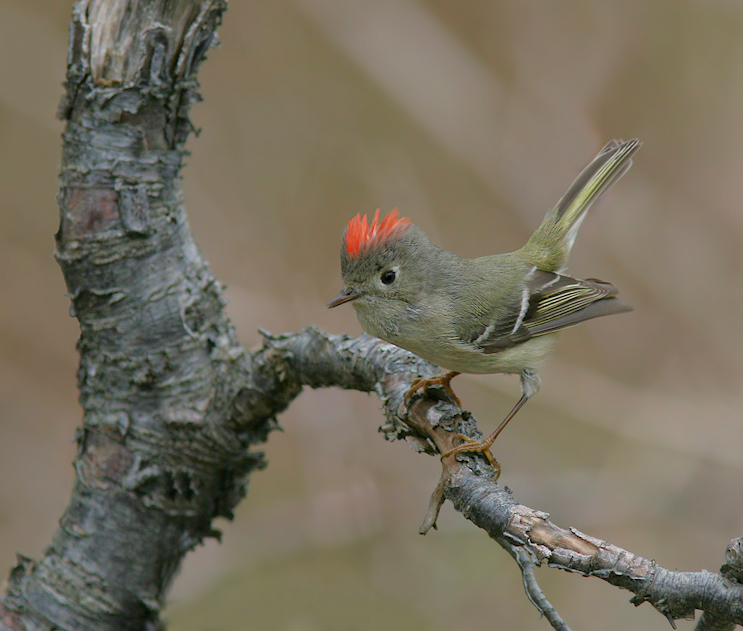
I remember the first time I heard a Ruby-crowned Kinglet singing. I thought what the heck is that! I search and searched looking for what could be singing so vociferously. Then when my binoculars fell on a Ruby-crowned Kinglet I could hardly believe it. How could such a loud, long song, come from such a small bird!

Sine that time Ruby-crowned Kinglets have been the bane of my birding efforts on more than one occasion. I remember doing bird surveys and straining to hear distant warblers, when all of a sudden a Ruby-crowned Kinglet starts wailing away from the tree tops. These birds have attitude to spare!

However, if they aren't singing Ruby-crowns (RCKI) can be somewhat difficult to see and they don't always show that nice Ruby crown.
Ruby-crowned Kinglet, while birding in newfoundland
Ruby-crowned Kinglet- The ruby crown is barely visible in this photo
and is often not visible in the field
What is always visible is a bold eye ring, a wing bar and those yellow/gold edges to the flight feathers. As well, RCKI's constantly seem agitated and flick their wings nervously as they move about. This is something most warbler species, do not do (Ruby-crowns aren't warblers of course, but are often with them in mixed flocks). As well, it's worth noting their call note at this time, since they only sing during the breeding season, the rest of the year their scratchy call note is all you'll hear.

Ruby-crowns are one of the first arriving songbirds in Newfoundland often arriving in late April or early May, when it is still quite cold. Interestingly, they leave quite early as well, since their numbers  thin out significantly into August and they can be hard to find in September.

Ruby-crowned Kinglet showing ruby crown
Ruby-crowned Kinglet showing off it's ruby crown


While they are in Newfoundland they do some amazing things, including lay a truly massive clutch of eggs. Ruby-crowns can lay up to 12 eggs and while each egg weighs on 1/15 of an ounce, the combined weight of the clutch can weigh the same as an adult Ruby-crowned!While you would think that all that singing and egg laying would burn a tremendous amount of energy, these frenetic birds are incredibly energy efficient and metabolic studies of Ruby-crowns have found that they can burn up to as little as 10 calories a day!

I'll leave you with a couple more photos of these little gems. See what I did there...gems...the bird's name is Ruby-crowned Kinglet...Ok, enough of that! Stay tuned for upcoming posts that will include more species profiles, quiz birds, ID features and much much more!

Ruby-crowned Kinglet showing ruby crown
A red mohawk any punk rocker would be jealous of!
Ruby-crowned Kinglet showing ruby crown
Notice me!

Friday, June 15, 2018

Old Friends Reunite!

I was looking through some old photos and came across one that I hadn't seen in a long time of two Yellow-legged Gulls, photographed together at Quidi Viki Lake, in St.John's, Newfoundland in early October 2011. While Yellow-legged Gull is a major rarity in North America, it has become somewhat of a Newfoundland winter specialty over the last 15 years or so, with one or more birds usually present from September- March. On this particular day I located two Yellow-legged Gulls together among a mixed flock of Gulls loafing in a ball field near Quidi Vidi Lake. While I was super excited  to see them, you can imagine their surprise when they saw each other some 2500+ km's from their Azores home! My fiance added the caption at the time.I thought it was amusing and figured I'd share it :)
Two Yellow-legged Gulls together in Newfoundland
YLGU's, presumably of Azorean origin. The individual on the right is perhaps a little more typical of fall birds with a more extensive hood of streaks. They are completely white headed by Christmas.

Thursday, June 14, 2018

Species Profile - Yellow-bellied Flycatcher


In keeping with the theme of highlighting Newfoundland's breeding Boreal species, today I've decided to take a closer look at Yellow-bellied Flycatcher.

Arriving in the last couple days of May or early June, this diminutive flycatchers song is part of the sound track of the Boreal Forest, along with Fox Sparrow, Blackpoll Warbler and Northern Waterthrush- just to name a few.

It's song is an almost comical 'chebek', or sometimes shortened to just 'bek'. It also uses a whistled 'chu-eee', which is oddly similar to the call note of Semipalmated Plover! Aside from those two common vocalizations it also has a lesser used third vocalization, which is a burry, 'churrr' (listen closely at 1:21)note. It often uses this call when moving from branch to branch or during inter-specific interactions.
Yellow-bellied Flycatcher in Newfoundland
Yellow-bellied Flycatcher

Yellow-bellied Flycatcher is by far the commonest flycatcher in Newfoundland and is often the only expected Empidonax flycatcher in the Eastern half of the province. In some central locations and South Western Newfoundland, the Empid situation gets a little more complicated, since Alder Flycatcher and Least Flycatcher are also possible (the latter being somewhat rare). However, with some experience, separating Yellow-bellied from these two species is relatively straight forward.

 Yellow-bellied is just that, yellow! In breeding plumage at least, it is significantly more yellow below than either Alder or Least, which can be quite pale. It's is also a more even green above, in relation to our other Empids- both Least and Alder can have some grayish areas on the upper parts, with least sometimes being quite grayish on the back of the head. It's most distinctive facial feature is it's bold yellow-buff eye ring, which is often peaked at the rear of the eye. Least Flycatchers eye ring can be similar, but never as yellow. Well, this wasn't meant to be an ID Empid ID piece, I'll save that for another post!
Yellow-bellied Flycatcher, yellow bellow and eye ring
Yellow-bellied Flycatcher (note the yellow belly!)

This has been a very trying breeding season for Yellow-bellied's this year with June temperature being, well below normal, with some areas experiencing heavy frost and even significant snowfall and freezing night time temperatures. Since Yellow-bellied Flycatchers feed almost exclusively on flying insects, they have been seen by meany people desperately searching for food on lawns and in other areas one would not usually see them.
Yellow-bellied Flycatcher in Newfoundland
Note the thick buffy eye-ring, peaked at the rear

Yellow-bellied Flycatcher in Newfoundland
Note the strongly bi-colored bill that I forget to mention in the body of the post!


Now into the middle of June, the Yellow Bellied's have been back for only a couple of weeks and they are already about 25% of the way through their stay in Newfoundland. It's a race against time for late migrants like the Yellow bellies. They migrate all the way from Central America to the northern Boreal forests, for at the most, a little over two months, only to turn around and endure a massive journey back to their wintering grounds. Lets hope our weather improves soon so these birds can get down to doing what they came here to do.


You can find a more thorough examination of the ID of Empidonax flycatchers in the article, "The Identification of Newfoundland Empids. Which gives a number of great tips for identifying Empids not only in Newfoundland, but anywhere!

Wednesday, June 13, 2018

Some Notes on the Identification of Juvenile Crossbills

I received a couple of photos from local birder Shawn Fitzpatrick today of a juvenile Crossbill. He never had exceptional looks at the bird but did manage to grab several photos. Quite often Crossbill identification is relatively straightforward. We have two species to consider, Red and White-winged. White winged Crossbill (owing to its name) has white bars on it's wings. In fact, it's often referred to as Two-barred Crossbill in Europe. As well, males of both species are shades of Red and females shades of yellow, they are different tones ,and as I said, identifying them generally isn't overly challenging.

However, in case I'm referring to, the bird was a juvenile, so entirely streaked brown and the photos were from essentially front on, so you really could not see if the bird had wing bars or not.So here is the bird in question.
juvenile White-winged Crossbill in Goulds, Newfoundland
Juvenile White-winged Crossbill (Photo Shawn Fitzpatrick)

Let me explain how I went about identifying this bird. The first thing I noticed about this bird was it's bill. One of the differences in White-winged and Red Crossbill is bill size (there are many types of Red Crossbills with varying bill sizes, but typically, Newfoundland Red Crossbills have larger bills than White-wined, it is both thicker and longer). This birds bill struck me as somewhat thin, not appearing overly robust or strong and seemed to narrow a lot towards the tip.
juvenile White-winged Crossbill in Newfoundland
Juvenile White-winged Crossbill (Photo Shawn Fitzpatrick)
The next thing that struck me was the length of the tail. One thing I have always noticed is White-winged Crossbills are a relatively long tailed Finch. Look at the birds tail in the second photo, notice, it's length notice how quickly it tapers as it extends from the birds back, almost like you pinched it between your fingers. Not look at the actual tail feathers. Notice how far the tail feathers extend beyond the under tail coverts, this bird has a tail. When you see them at some distance, their tail length is almost reminiscent of Pine Grosbeak- though certainly not as long.At any rate it is significantly longer than Red Cross bill, which at times hardly seems to have much of a tail at all. When you see Red Crossbills in the tree tops, you often don't notice their tails that much, since they are quite short. Note this, when you are viewing Crossbills in the future.


Juvenile Red Crossbill, Newfoundland
Juvenile Red Crossbill- Note the difference in bill size with the above bird. Note especially how the upper mandible tends to be thicker towards the tip.

One other feature that kind of struck me about the bird above was the pattern of streaking. The streaks seemed fine, on a relatively pale base, especially around the side of the face (ear coverts). I'm pretty sure this is variable and will change quickly as birds mature, but the bird in the first two photos, has a facial pattern kind of reminded me of Pine Siskin. Now look at the bird in the photo just above. Note how the face is a little more solidly coloured.

One other feature that I noted in the second photo above was the amount of fine streaking on the birds shoulders (scapulars). Note the juvenile Red Crossbills above, how plain brown the shoulders are. I'm not entirely sure how reliable these feature are, there are perhaps at best an accessory. It's something I'll continue to look for when I see these species.

I'd like to thank Shawn for send me the photos and inspiring this post.


The Charismatic Boreal Chickadee (Poecile hudsonicus)

One thing I have gained from guiding over the years is much greater appreciation for our native Newfoundland species. That is one of the great things about guiding, you never really get complacent about your 'common' local species, because you are always aware of how special they are to your visitors.

One species, we as Newfoundlanders, tend to take for granted is Boreal Chickadee. While it is quite similar to the much more widespread Black-capped Chickadee, there is just something about it. Maybe it's their insistance to fend for themselves, and not rely on bird feeders; maybe it's their hoarse voice. For whatever reason, they are a species that has always captured my heart and it's easy to see why it's such a sought after species for visiting birders, from more southern locales.

I'll leave you with several photos. Stay tuned for upcoming blogs, where I will continue to showcase some of our native Boreal species and will include some interesting identification tidbits as well!

Thanks for reading!

Boreal Chickadee, while birding in Newfoundland

Boreal Chickadee, winter birding in Newfounldand
While perhaps not the best photo, I like how this capture the spirit of the Boreal Chickadee, unfazed by winters icy grip!

Winter birding in newfoundland, Boreal Chickadee


Boreal Chickadee photography, Newfoundland
One of my favourite photos of the species that I've captured. This pose really ups the 'cute' factor!

Monday, June 11, 2018

Another Day, Another Post


 I'm really going to making a conscious effort to post as much as possible going forward. I would ask if you are seeing this can you please take a moment to like and perhaps share my Facebook Page.
Over time, I will be posting lots interesting quality content, there as well. It would really help in growing the Birding Newfoundland brand.

For now I will leave you with some photos, everyone likes photos right?! I have lots of ideas for some quality education content and ID articles in the coming weeks and months, so be sure to stay tuned!
Some of my favourite Newfoundland warbler species. Always challenging to photograph, but so rewarding when you get those nice shots.

One of the new things I'm decided to offer are personal photo trips. I will not tell you how to operate your camera ( I can suggest) because that's not what I'm good at! I will however give you advice about bird behaviour, help you learn bird song and provide you with a great deal more advice that can help you improve your images. Please feel free to check out my website.

magnolia Warbler found while birding in newfoundland
Magnolia Warbler

Northern Waterthrush in Balsam Fir in Newfoundland
Northern Waterthrush


Mourning Warbler found while birding in Newfoundland
Mourning Warbler

Yellow Warbler found while birding in Newfoundland
Yellow Warbler


Bay-breasted Warbler, Codroy Valley
Bay-breasted Warbler

Saturday, June 9, 2018

I'm Back in a Big Way!

After a hiatus of many years I am finally back. While day jobs kept me away from guiding and writing about birds for the last number of years, I have now decided to return to birding, guiding and writing full time!

I have just launched my website https://www.birdingnewfoundland.com. Please, if you can take a few minutes to have a quick look around the site and if you were so inclined, you could also take a minute to give a like to my Facebook Page https://www.facebook.com/birdingnewfoundland/.

I will be updating this page on a regular basis going forward and it will likely get a complete facelift as well.

For many of you who have sent me identification questions regarding Gulls, shorebird etc. Be sure to check out the tutoring section of my new website.

That's it for now, but you will be hearing from me again soon!

Thursday, August 30, 2012

Solving a Warbler Mystery

Well,after a long layoff, I'm finally back. Over the last several months I've spent some time out of town working and doing things just not associated with birding. It was always my plan after the big year to take some time off and focus on non-birding related activities but now that fall migration is in full swing, I'm back. 

I was prompted to write this article by a birding friend of mine who sent me several photos of a 'mystery' warbler. Mostly the bird was a mystery because the photos were quite blurry,but this is often the case with fall warblers, especially the more furtive species. So, my purpose for writing this is twofold. Firstly, I'll seek to identify the mystery warbler and in doing so I'll provide reasoning to support my conclusion. Along the way, I'll also try to shed some light on fall warbler identification in general and outline a basic approach for tackling such problematic birds.

 So lets get right to it. Below you will see several photos, none of which are clear and none of which show the entire bird. In order to even begin to identify this bird we need to put the pieces of the puzzle together. I'm not sure the identification would have been possible if any one of these photos were missing,since all of them provide vital clues. Lets look at each photo separately and work towards an identification, ruling some species out along the way.
At first look this photo might useless,since its just a blur. While it doesn't show any plumage detail it does give us some critical information about the birds general shape,posture and color.The bird appears to be greenish above, rich yellow below and having a grey head. Its a profile view and no wing bars are visible, but the photo is so blurry that I'm not sure they would show up, so this is at most circumstantial. I think the large yellow spot on the rump is an out of focus leaf or some type of reflection,since it intersects the wing and just doesn't look quite right.Here are the key features to take from this photo

- green above
-yellow below
- greyish head
- upright posture
 -probably lacking wing bars

 Using this list we can already rule out most species and create a list of possible species including;
1) Mourning Warbler
2) Connecticut Warbler
3) Macgilivary's Warbler
4) Nashville Warbler
5) Orange-crowned Warbler
6) Magnolia Warbler

 So let's keep these possibilities in mind as we move to the next 3 photos.


This photo adds some more pieces to the puzzle.In this photo we can clearly see the bird does indeed have a olive/grey hood. It also appears to have a broken eye ring, with a darkish line through the eye. The photo is still pretty blurry so again this feature is only useful in combination with other characters. We can also see what looks like an odd yellowish spot between the eye and the bill. This is quite strange doesn't really seem to mesh with any of the possibilities we outlined above!Also, worth noting is the yellow undertail coverts and a thickish looking all green undertail,lacking tail spots.Also, the bill appears somewhat thick (as warblers go),but this can be misleading in a blurry photo,but it sure doesn't look needle thin.

 Once again the bird is standing quite upright and to me at least the legs appear as though they are pale.Leg color is a critical detail and useful in the separation of some very similar species

.So,to recap we know that the mystery bird is; - green above -yellow below - greyish head - upright posture -probably lacking wing bars - has a broken eye ring with what appears to be a dark eye line - seems to have an odd yellowish spot in the lores or supra loral area - yellow undertail coverts - green undertail feathers-lacking tail spots


When I first saw this photo it confused me. The bird seems to have a pale supercilium and a dark eye line. This didn't fit with the species I had in mind at the time,until I gave it some thought.The yellow throat was a key piece of information though. In fact, after seeing the first two photos, this photo that initially confused me pretty much clinched the identification. So, to the above list we can add what looks like a pale supercilium and a yellow throat.


Again at first look this photo might seem useless. Actually it took me a second to even realize what I was looking at when I saw this photo initially. Then after a couple of seconds the birds head revealed itself and if you look hard enough you can see the broken eye ring,at least on the bottom of the eye.That's pretty much all I took from this photo.

Now that we've gathered all our evidence and created a list of possible suspects its time to start narrowing things down a bit. To aid this process we'll make use of some background information as well. I'll break down the list one by one until we arrive at the identification.

 1)Connecticut Warbler- There are three records for Newfoundland, all in late September. This bird is rarely seen in the east before mid to late September, this is a big strike against this bird.If that wasn't enough the lack of a thick,bold eye ring and the presence of a bright yellow throat rule this species out.

 2) Macgillivary's Warbler- Western Species that is extremely rare in the east. When it does appear it generally does so in late fall. There aren't any records for Newfoundland. While this makes this species unlikely it isn't enough to rule it out. However,I'd expect even an immature Magillivary's to show a much more defined split eye ring and should not show a yellow throat. The adults of course have a dark grey,backish throat and the immatures have a whitish throat, but never yellow.

3) Nashville Warbler- a very uncommon breeder in Newfoundland, but a few do turn up every fall. The greyish head, green above yellow below with yellow throat do match this species, so maybe that's it! Not so quick. Nashville Warblers have a VERY bold eyering,they also have black legs and a very fine, pointed bill.They also,never show any kind of dark eye line. So you can check that off too.

 4) Orange-crowned Warbler- This bird could superficially resemble an OCWA. The greyish head, with split eye ring, dark eye line actually are very good OCWA characters, however that's where the resemblence ends. Orange-crowned Warblers are late migrants and the few that do turn up in Newfoundland every year do so usually in October or later, maybe early as late September. Again its not impossible that one could turn up here in August, but this bird is just too bright below for an OCWA. Also the posture doesn't look quite right and the apparent pale legs are also wrong for this species...moving on.

 5) Magnolia Warbler- A common breeder and routine in late summer/fall in eastern Newfoundland,so a good start. However,its just clear that this bird is not a Magnolia Warbler. We have to look no further than the under side of this birds tail to give us all the information we need. Magnolia Warblers have white under tail coverts and a unique black and white pattern on the under side of their tail feathers. This bird clearly has yellow under tail coverts and green under side of the tail feathers.So after all of this deducing, we are left with a single possibility, Mourning Warbler.So lets consider that.

 Mourning Warbler is a common breeder in parts of Newfoundland and a patchy breeder in the east. They are seen with some regularity in the alder beds on of eastern Newfoundland in late summer and the first half of September. As well, all of the characters list above fit we will with this species. It is green above, yellow below and lacks wing bars. It has yellow under tail coverts and green underside to its tail feathers,lacking tail spots. It spends much time walking and often has an upright posture,it has pale pink legs and as other members of the genus Opornis, it has quite a thick bill for a warbler.As well, immatures of this species do show a moderate,split eye ring, with a dark eye line. There is also often a yellowish line running above the lore,in immatures,which is somewhat reminiscent of Kentucky Warbler. In a couple of the photos above there is a yellowish area in front of the eye and I think its explained by this feature, but looks larger because the photo is blurred. Look at the web photo below for an example of what I'm referring to. This is not a character that you see talked about in field guides, but is clearly present.


As you can see there is much to consider when making these identifications and while it took quite some time to present this reasoning here,the exact same method is employed, to make split second identifications in the field. The more you practice the quicker you get at making such evaluations on the spot.

If you would like to get some insight into using this type of reasoning to identify fall warblers, I'll be holding a fall warbler identification workshop on either Sept 8th or 9th. It will be 3-4 hours and will include my usual power point slide show. I'll be breaking down all the look alike and confusion species. Space is limited and the registration fee is $50. If you interested contact me at dave.browneATgmail.com to reserve your spot.

Tuesday, December 13, 2011

For the Larophiles....

I was just browsing some of the blogs I follow and I happened upon one from Nick Bonomo from CT. It will seem a very familiar conversation for any larophile. It made me think back to the days when I looked forward to spending Christmas day at the dump....

I've got an idea for a sequel that I might post later this week.

http://www.shorebirder.com/2010/11/gulling-at-landfill.html

Popular Posts